Bookmaker
In the world of sports betting, we all talk about odds, markets, predictions, streaks, or intuition…
But there’s one silent figure that, no matter what happens, always plays with an edge: the bookmaker.
Sometimes we underestimate them. Other times, we hate them. But if you want to become a serious bettor, the first step is to understand how they work, how they profit, and how you can stop playing by their rules.
What is a bookmaker?
A bookmaker (or betting house) is a company that sets odds, offers betting markets, and accepts wagers from users on different outcomes of sporting events—or even political, cultural, or social events.
In theory, they simply facilitate the betting process.
But in reality, they do much more than that: they design the rules so that the system always works in their favor.
They’re not there to predict outcomes.
They’re there to manage risk and maximize profit, no matter what happens in the event.
The Real Business of a Bookmaker: How they make money
Bookmakers don’t rely on luck.
Their business is built on margins, probability, and volume.
Here’s how it works:
They estimate the true probability of each possible outcome.
For example, in a balanced match, they might estimate:
Home team: 33.33% (fair odds: 3.00)
Draw: 33.33% (fair odds: 3.00)
Away team: 33.33% (fair odds: 3.00)
But they won’t offer you fair odds. Instead, they might offer:
Home: 2.80
Draw: 2.90
Away: 2.85
When you convert those odds into implied probabilities, the total exceeds 100%.
In this example, it adds up to about 106%.
That extra 6% is their margin—their hidden profit.
This is what’s known as the Book Value or overround.
It doesn’t matter who wins the match. Over time, that margin guarantees them mathematical profit.

The Big Opportunity with bookmakers: What if they get it wrong?
Now it gets interesting. Bookmakers are not perfect.
They can make mistakes due to:
Late or incorrect information
Unbalanced market volume
Slow reaction to odds changes at other bookies
Simple human or technical error
And these mistakes translate into mispriced odds, which actually offer more value than they should.
Betting in those moments is what’s known as placing a value bet.
Value Bets: When the Bettor Takes the Lead vs the Bookmaker
A value bet happens when the real probability of something happening is higher than the probability implied by the odds.
Example:
The fair odds (60% probability) should be 1.66.
But the bookmaker, due to error or delay, offers 1.90.
That’s real value. Mathematically, that bet is profitable over the long term.
Professional bettors don’t bet based on intuition.
They search, hunt, and place value bets.
How AI Capitalizes on Bookie (bookmaker) Mistakes
Bookies aren’t stupid. They correct fast. Sometimes in seconds.
Those opportunities don’t last, and if you don’t act with precision and speed, they’re gone.
That’s why competing manually against an algorithmic system is a losing game.
You need technology that plays at their level—or better.
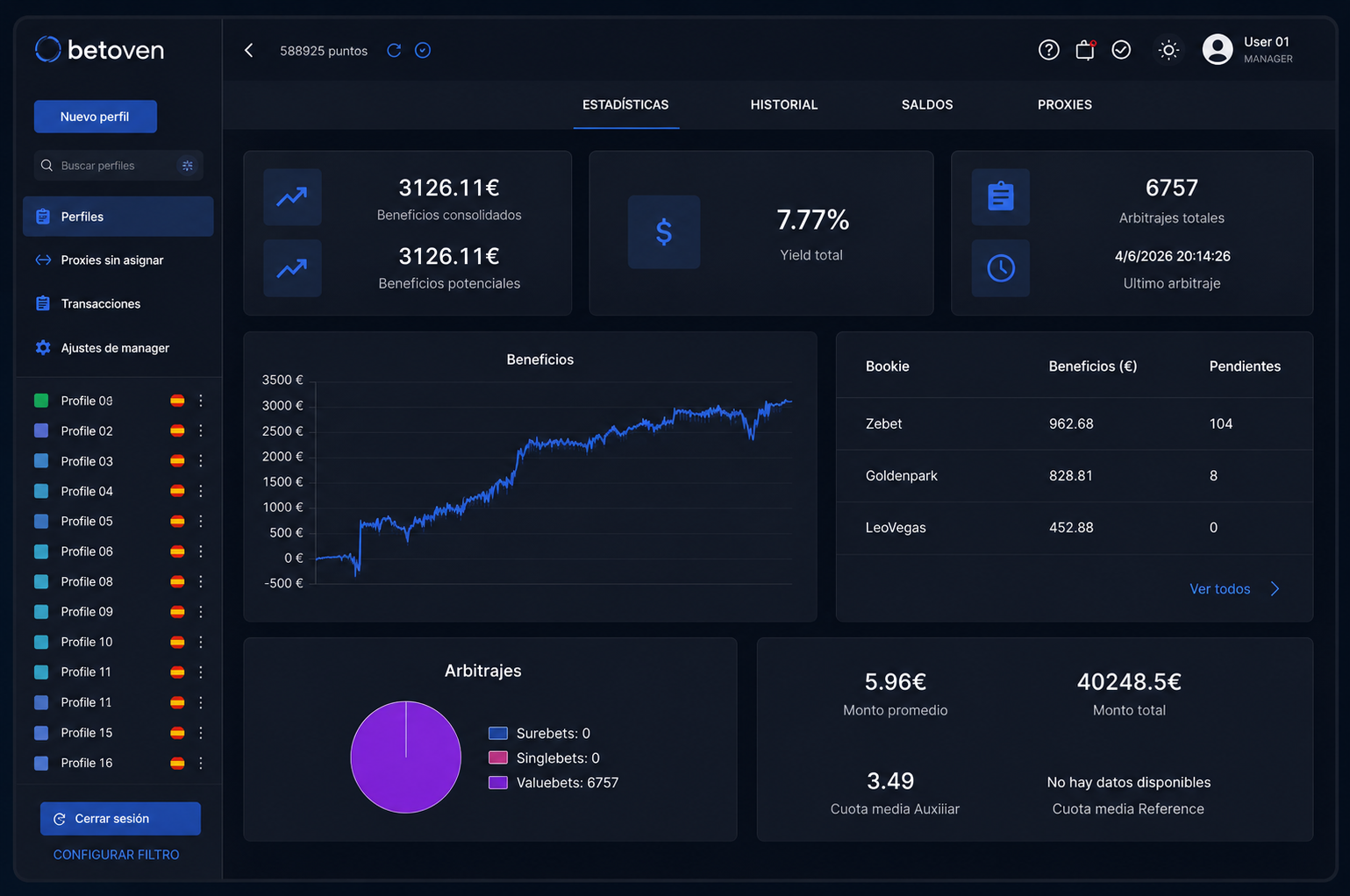
This is where BetOven comes in.
It doesn’t bet on gut feeling.
It doesn’t need to watch matches.
It doesn’t improvise.
What it does is:
Monitor odds in real time across multiple bookmakers
Automatically detect pricing errors
Calculate if there’s real statistical value
Only place bets when there’s an edge
Execute in seconds
It’s like having a team of traders and analysts working 24/7 to find value for you—with zero human error.
And best of all: it does it from your account, using your balance, at your chosen bookmaker.