
What are surebets
and how to make them
By Aitor Hunt · Updated 30 September 2026
‘Surebet’ is simply ‘sure bet’ written as one word, and you will also see the topic called sports arbitrage, arbitrage betting or arbing. A word of caution about the name: what is ‘sure’ is the maths. The bets still have to be placed properly, and that is also what this guide is about.
What is a surebet? The meaning of ‘sure bet’
In everyday English, ‘a sure bet’ is something certain to happen. In betting, a surebet means something more specific: backing every possible outcome of the same event, spread across different bookmakers, taking advantage of the fact that their odds don’t agree. If the stakes are split correctly and every bookmaker accepts every bet at those odds, all outcomes are covered: the return is the same whoever wins, and higher than the total staked. That mathematical margin doesn’t depend on any prediction.
Why do surebets exist?
Because each bookmaker sets its own odds and moves them at its own pace. Once the match is under way, after a break of serve, a goal or a red card, some bookmakers react within a second and others take a little longer: for that short time, two bookmakers disagree about the same match.
Normally it works the other way round: if you back both sides with the same bookmaker, you always lose a little. With both outcomes at 1.90 and £100 on each, you stake £200 and get £190 back whoever wins; that £10 is the bookmaker’s margin. A surebet appears when you combine two bookmakers that disagree so much that, taking the best odds from each, that margin turns the other way. As long as bookmakers adjust their odds at different speeds, surebets will keep appearing: what makes the difference is who gets to the odds first.
A real surebet example
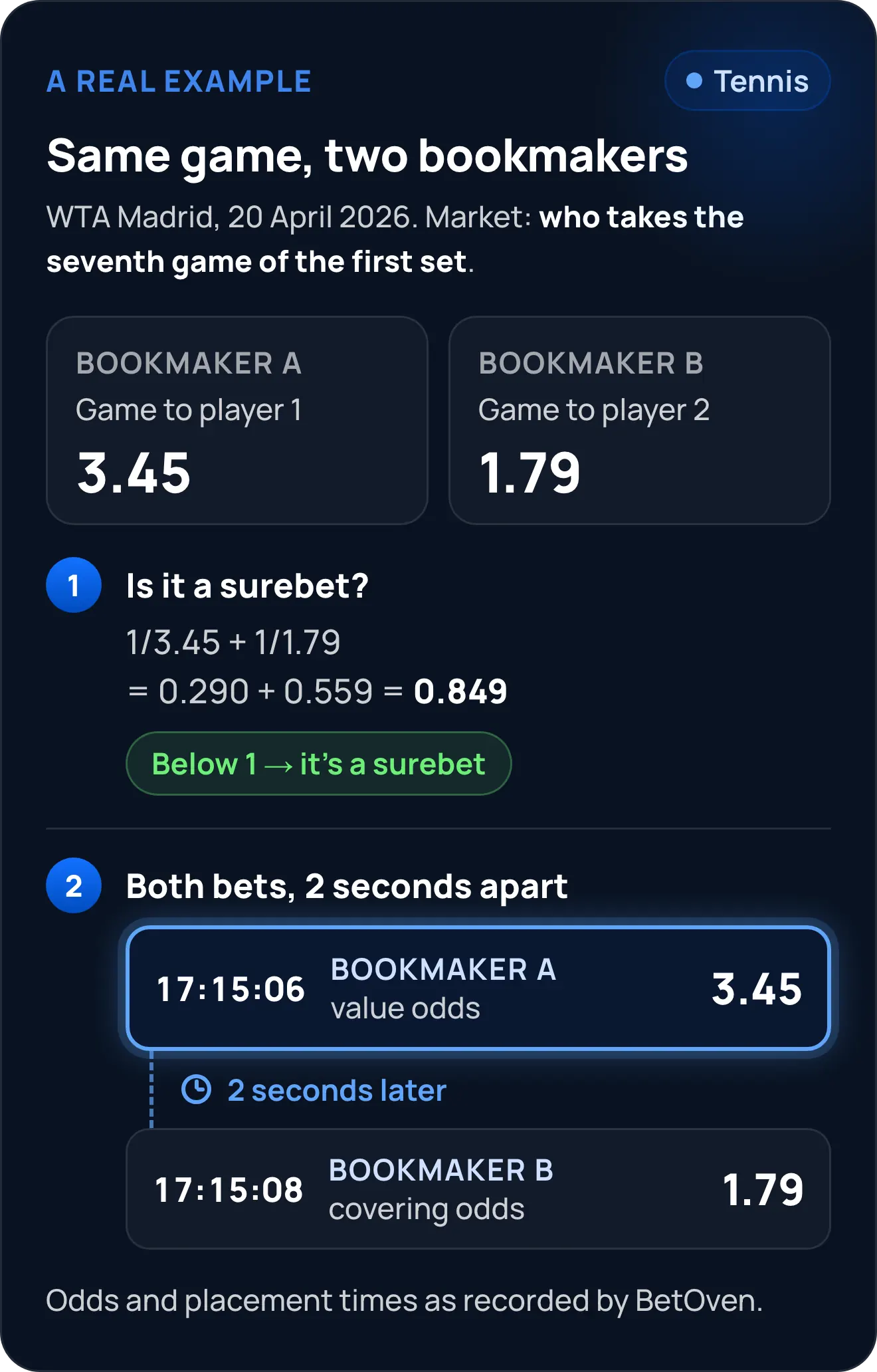
Like most things, a surebet is easier to understand with an example, and this one is real: a surebet placed by BetOven on 20 April 2026. Tennis, WTA Madrid, and the market is who wins the seventh game of the first set.
1. Two bookmakers, two odds that don’t add up. One bookmaker was offering 3.45 on player 1 taking the game, and another 1.79 on player 2. Each bookmaker moves its odds at its own pace and, for a few seconds, these two left a margin: 1/3.45 + 1/1.79 = 0.849, below 1.
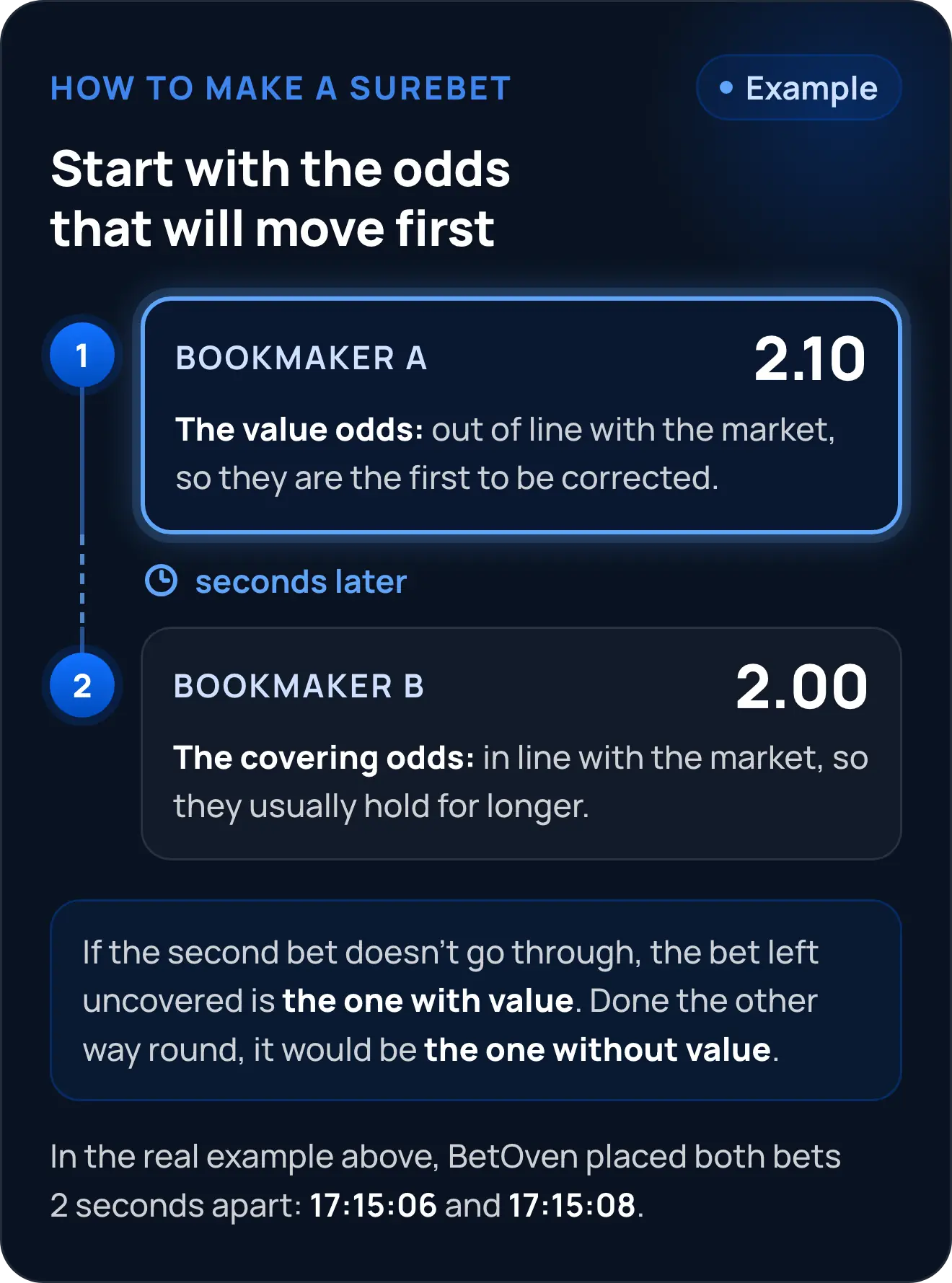
2. BetOven splits the stake and places both bets 2 seconds apart. It works out how much to put on each side so that either result returns almost the same. The value odds go in first, the ones that were out of line with the market and are the first to be corrected (17:15:06), and two seconds later the bet that covers them (17:15:08).
3. Every outcome covered. Once both bets had been accepted at those odds, both possible results of the game were covered.
A margin that wide is rare and lasts only seconds; most surebets are much tighter than this one, and they disappear just as fast. That is why speed matters so much: by hand, by the time you have opened the second bookmaker and worked out the stake, the odds have often moved.
How to calculate a surebet
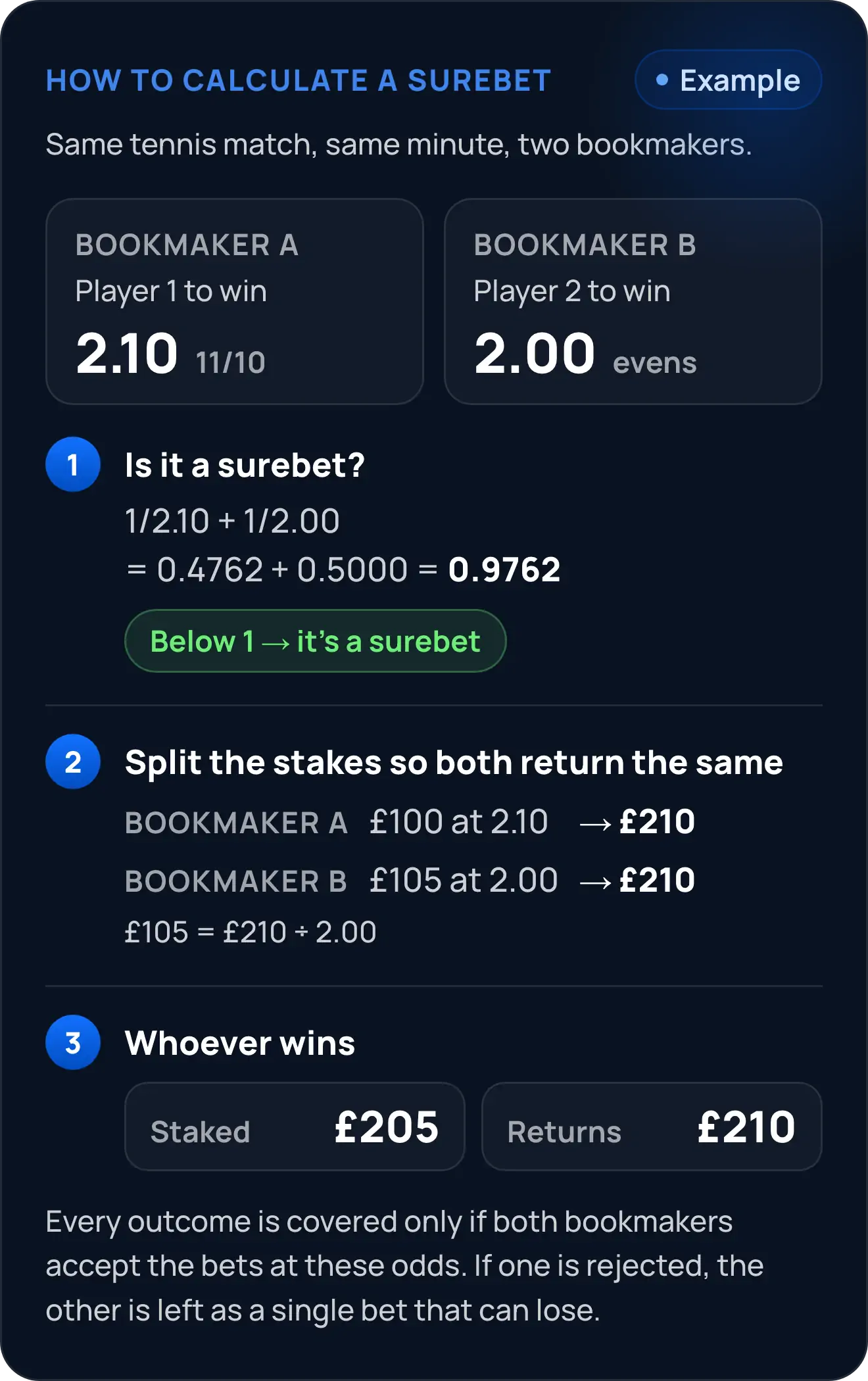
To check whether two odds make a surebet, divide 1 by each of the odds and add the results together. If the total is below 1, it is a surebet; the further below 1, the wider the margin.
1/odds A + 1/odds B < 1
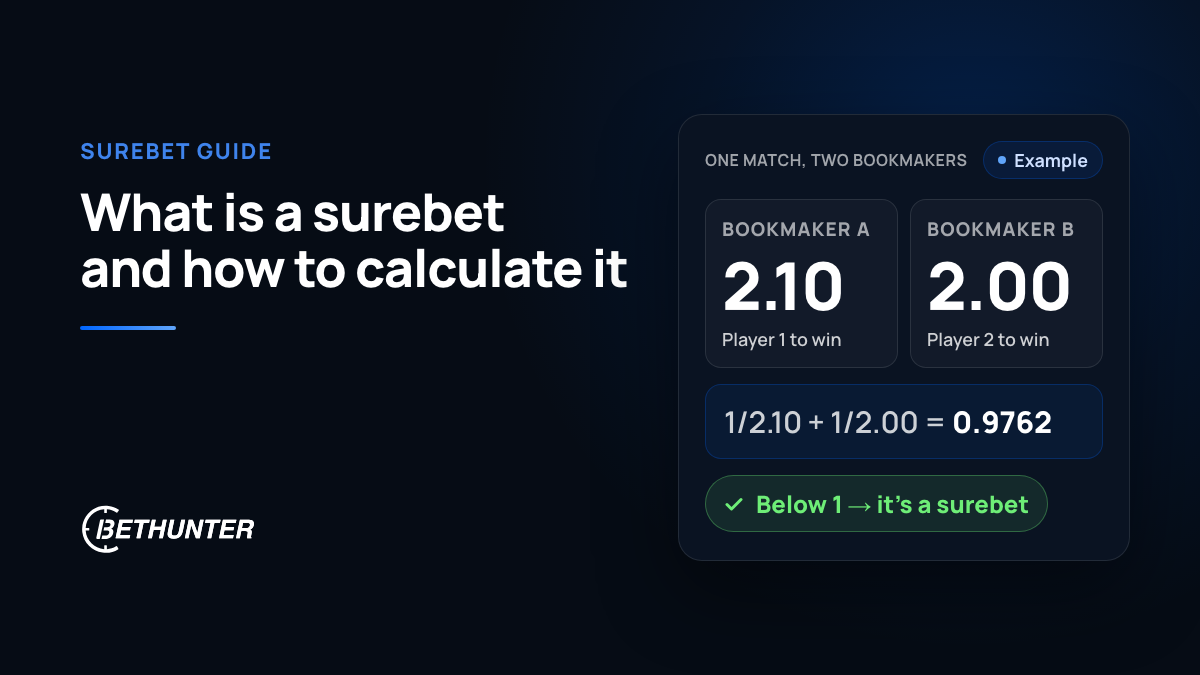
Take the real case in this article: 1/3.45 + 1/1.79 = 0.290 + 0.559 = 0.849. That is below 1, so it is a surebet. With a simpler example, such as 2.10 and 2.00, the total is 0.976: that is the example in the graphic.
To split the stakes, each bet gets the total stake × (1/its odds) ÷ the sum (0.976 in the graphic’s example). With £205 in all, that gives £100 at 2.10 and £105 at 2.00. Either result then returns £210, provided both bookmakers accept the bets at those odds; if one of them is rejected, the other is left as a single bet that can lose.
The hard part is doing that sum by hand while the odds are moving. That is what our surebet calculator is for, as are surebet scanners: programs that read many bookmakers’ odds non-stop and flag any pair that makes a surebet. If you want software that not only finds surebets but also places them, that is what BetOven does.
Where and how to find surebets
You can find surebets in almost any sport, before events and, above all, while they are being played, which is when odds move most and where BetOven works.
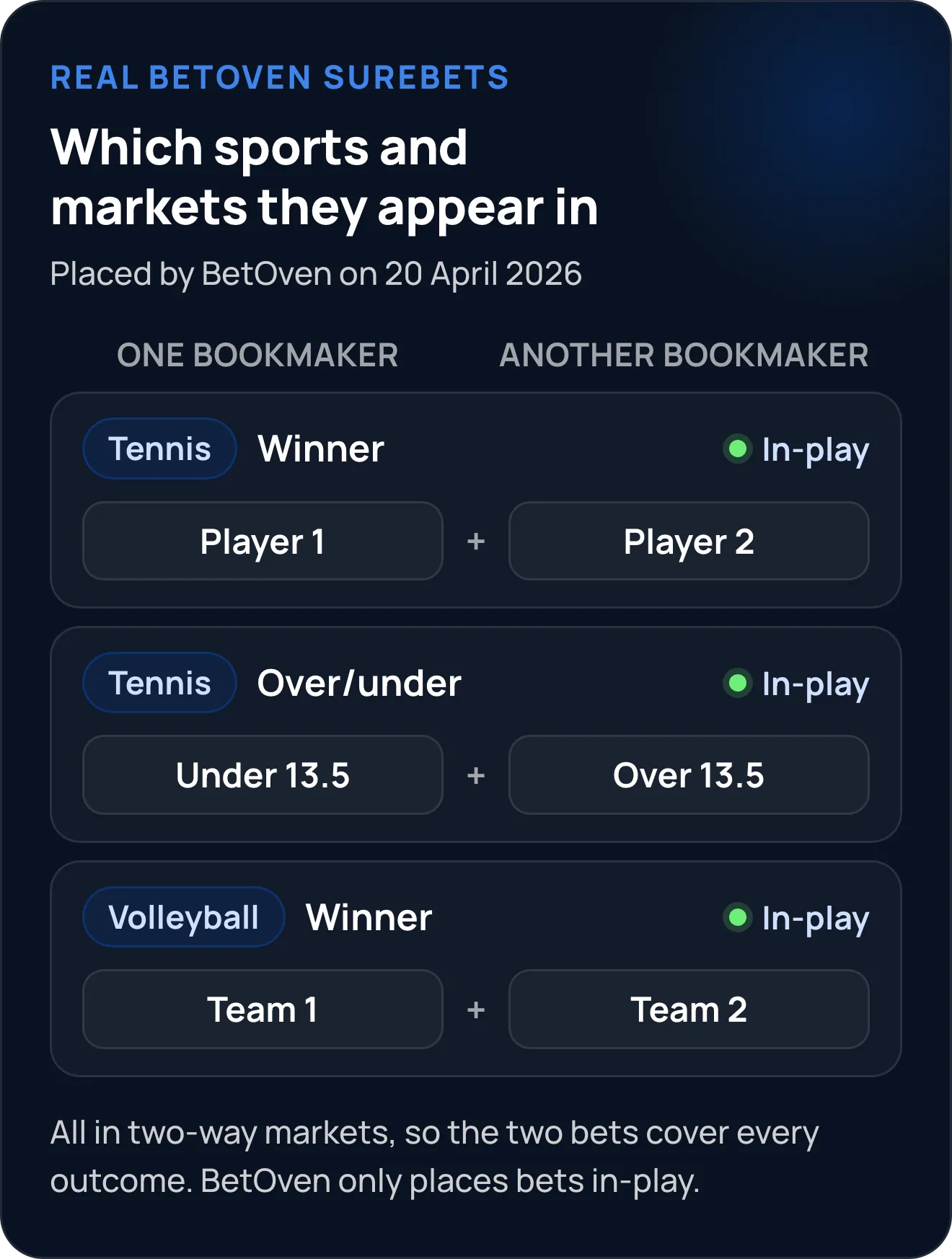
Bookmakers offer plenty of two-way markets that let you make simple sure bets. The sports with the most sure bets are football, tennis and basketball, simply because bookmakers offer more markets on them.
The sports you can make sure bets on with our surebet software are: volleyball, baseball, ice hockey, basketball, tennis, American football, table tennis, football, beach volleyball, rugby, futsal, badminton and handball.
To find surebets for free, there is BetOven Scanner: it is free, compares bookmakers’ odds in real time and flags surebets and valuebets so that you can place them yourself. And our guide to which bookmakers to start making surebets with helps you choose where to begin.
How to make a surebet: the two-step method
A surebet is usually placed in two steps: first the bet on the value odds, the ones that are out of line with the market (often at the less stable bookmaker); then, once that bet has been accepted, the covering bet, usually at a more stable bookmaker.
The reasoning is simple: the value odds are the first to be corrected, so they leave you the least time; the other odds usually hold for longer. If the second bet doesn’t go through, the bet left uncovered is the first one, on the value odds. That doesn’t make it a value bet: it can win or lose. It is the same order BetOven follows: in the real example in this article, the first bet went in at 17:15:06 and the covering bet at 17:15:08.
If one of your bookmakers has restricted your account, look for surebets where the value odds are at that bookmaker: that way, if it cuts your stake or rejects the bet, you have not yet bet at the other one. And before you start, you need funds in all your bookmaker accounts at once, because each surebet uses two of them at the same time.
What are automated surebets?
Automated surebets are simply the natural evolution of a classic surebet finder: instead of alerting you so that you place the bets yourself, the software places them.
In practice, it means placing surebets automatically, using sports betting software or surebet bots that scan the odds, find surebets and place them according to parameters you have set in advance.
A clear example of a surebet bot is BetOven: it detects surebets, works out the stakes and places both bets automatically, in your own bookmaker accounts, in-play only and only with bookmakers licensed in the market you bet in. It is Windows desktop software (on a Mac, you can run it with Parallels or on a remote server); we help you install and configure it over AnyDesk, and after that it runs unattended while your computer is on. Your part is to fund your bookmaker accounts and check your settings, balances and any changes at the bookmakers from time to time.
One thing to be clear about from the start: bookmakers can restrict or close accounts that bet this way, whether by hand or with software. BetOven spreads your betting across several bookmaker accounts, but it does not prevent an operator from restricting one.
Making surebets with BetOven
Here is what the software does when you work with surebets:
In-house algorithm
Detects the surebet, works out the stakes and places both bets within seconds, always starting with the value odds, which are the first to move.
Real-time tracking
Follow every bet it places in real time in the app, and check your history, balances and stats by bookmaker from your phone, in the web panel.
All your bookmakers at once
Works with all your bookmaker accounts at the same time, one per bookmaker and in your own name, each with its own balance, settings and history.
Set up your way
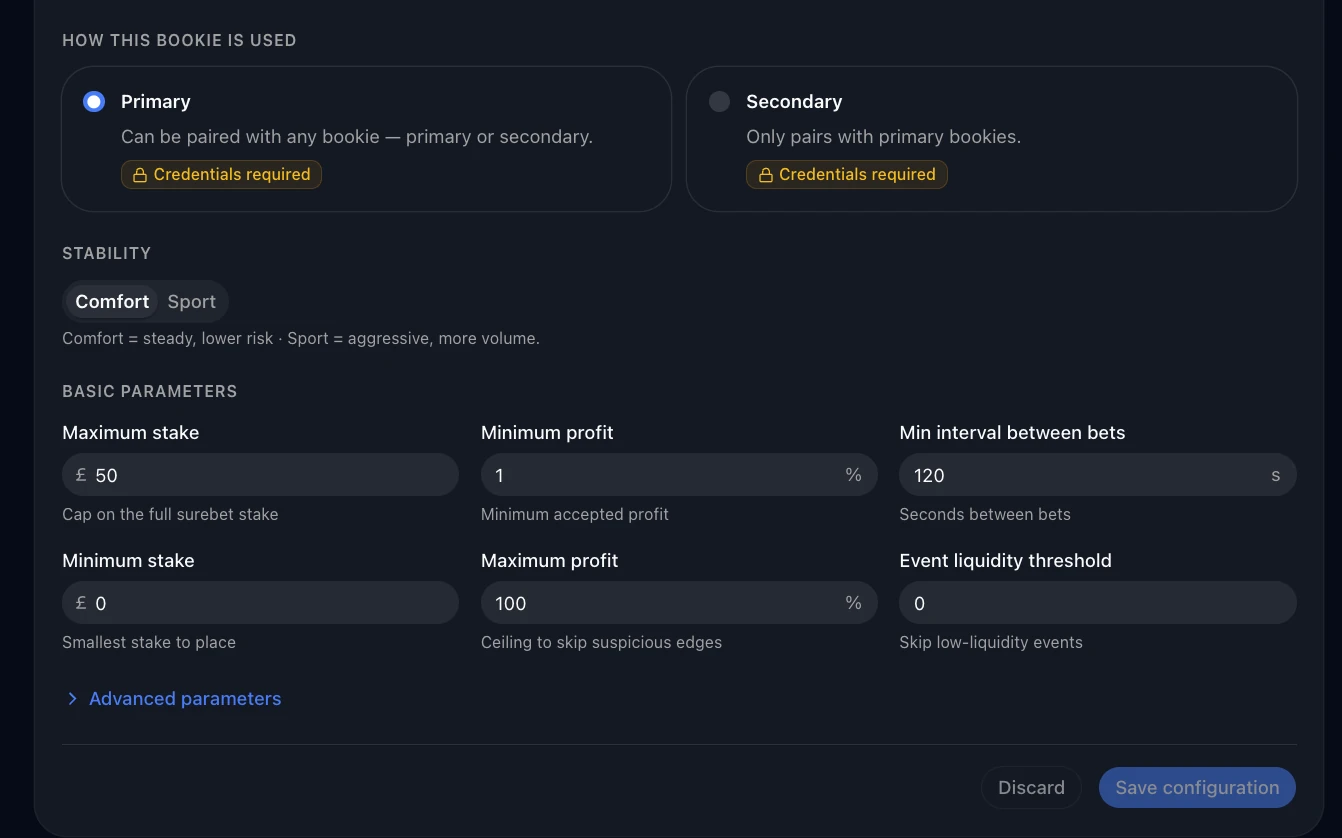
You decide the strategy: which bookmakers, which filters, what stakes and at what times.
Support in English
We help you by chat, email or WhatsApp, depending on your plan, in English, Spanish or Italian.
Encrypted credentials
Your bookmaker passwords are stored encrypted with a key you create, which is not kept on our servers.
Frequently asked questions about surebets
Types of surebets
Surebets are combinations of bets, so they are classified by whether those bets are placed before the event (pre-match) or while it is being played (in-play).
Pre-match surebets: placed before the event starts. The odds are set well in advance and are very stable, so wide margins are very hard to find.
Surebets with wide margins are rare before the match, and account restrictions tend to come even sooner, because arbitrage is easier for bookmakers to spot there. I would not recommend them.
In-play surebets: also known as live surebets, they are placed while the event is under way. The odds change within seconds depending on what happens in the match, so bookmakers disagree more often.
These are the surebets that matter for sports arbitrage, and they are the ones BetOven places automatically: it works in-play only.
And by sport: in two-outcome sports such as tennis, two bets are enough. Where a draw is possible, as in football, there are two options: cover the draw as well, with three bets, or stick to markets with only two outcomes, such as handicaps or over/under goals.
Are surebets completely safe?
It may sound too good to be true, so let’s be clear: the maths is real. A surebet covers every outcome and leaves a mathematical margin, provided every bet is accepted at those odds. But is making surebets completely safe?
No: a surebet covers you against the result of the match, but not against the execution. You have to place at least two bets with two different bookmakers and, in-play, each one takes a few seconds to be accepted. In that time three things can go wrong: the odds change or the bookmaker suspends the market, the bookmaker accepts only part of your stake, or you make a mistake placing it (wrong market, wrong player or an extra zero). And watch the rules: in tennis, if a player retires, some bookmakers void the bet and others settle it in favour of the opponent.
How do you keep that under control? By always placing the value odds first, as they are the first to change; by checking both bookmakers’ rules beforehand; and by placing both bets within seconds, with no rush and no typing errors. That is exactly the kind of repetitive task software is built for.
What happens if I don’t complete a surebet?
It happens when the second bet doesn’t go through: because the odds have changed, because the bookmaker has suspended that market (sometimes it does so when it spots possible arbitrage), because it won’t accept your full stake (every account has a maximum per market, and it is lower if the bookmaker has restricted you), because it takes too long to accept it or because it rejects it. The first bet is then left as a single bet, which can win or lose.
Is it a value bet? No. If you placed the value odds first, the ones that were paying more than the rest of the market, the bet left on its own comes from odds with value, but it can lose that value during execution, because of the extra checks needed to secure the surebet, and it doesn’t have the yield of a value bet. In the UK and Spain, over the year, single bets take away roughly a third of what you make with surebets; it varies from month to month: in some months they add and in others they take away. BetOven always starts with the value odds because they are the first to change.
With the uncovered bet you have two options: cover it anyway and accept a small loss rather than risk the whole stake (that is a negative surebet, explained below), or let it run. In BetOven, whether to close it or let it run is up to you in the settings. And if a bookmaker won’t accept the full stake, BetOven can complete the surebet with several bets at that bookmaker.
Sometimes the odds also come back: in-play, odds keep moving, and what stopped being a surebet can become one again seconds or minutes later.
Is it legal to make surebets?
Yes. We tend to assume that when something looks too good to be true, there must be something illegal behind it. That is not the case here: making surebets is legal. They are ordinary bets, placed from your own accounts with bookmakers licensed to take bets in your market; what is unusual is how you combine them.
At heart it is a form of arbitrage, the same idea as currency arbitrage in financial markets: taking advantage of two places putting a different price on the same thing.
Fine, making surebets is legal, but is it legal to do it with software?
Yes: using a program to find surebets and place them on your own accounts is not illegal. Your bets remain subject to each bookmaker’s terms, and what can happen, whether you bet by hand or with a bot, is that a bookmaker restricts your account: we cover that in ‘What is the big downside of surebets?’.
Is there anything illegal in the world of surebets?
Making surebets is not illegal. What is illegal, and has nothing to do with surebets, is opening or using accounts under someone else’s identity, something that has been seen in betting in general when a player gets restricted.
Today it is much harder, for several reasons:
- Bookmakers must check that withdrawals go to bank accounts or e-wallets in the player’s name. So even if a third party got into your account, they could not move the money to theirs.
- Bookmakers’ identity checks are far more thorough than they used to be, and they sometimes ask for extra documents to prove you are who you say you are.
- Each account must be in the name of the person betting with it: bookmakers require it in their terms.
In BetOven, your bookmaker credentials are also stored encrypted with a password you create, which is not kept on our servers.
Tips for making surebets
Use several bookmakers
Every surebet needs at least two bookmakers, and the more you have (one account each, in your own name), the more pairs of odds there are to compare. If you bet by hand, always check the odds just before placing each bet, including when you use a scanner, which flags the surebet but does not place it: odds change in seconds and markets get suspended. With BetOven you don’t need to, because it places both bets itself.
Stay calm
Surebets can look too good to be true, but don’t let that carry you away. Make sure you understand how they work before you move larger stakes.
Manage your bankroll
Probably the most important tip. Even with surebets, keep track of your bankroll and only ever bet money you can afford to lose.
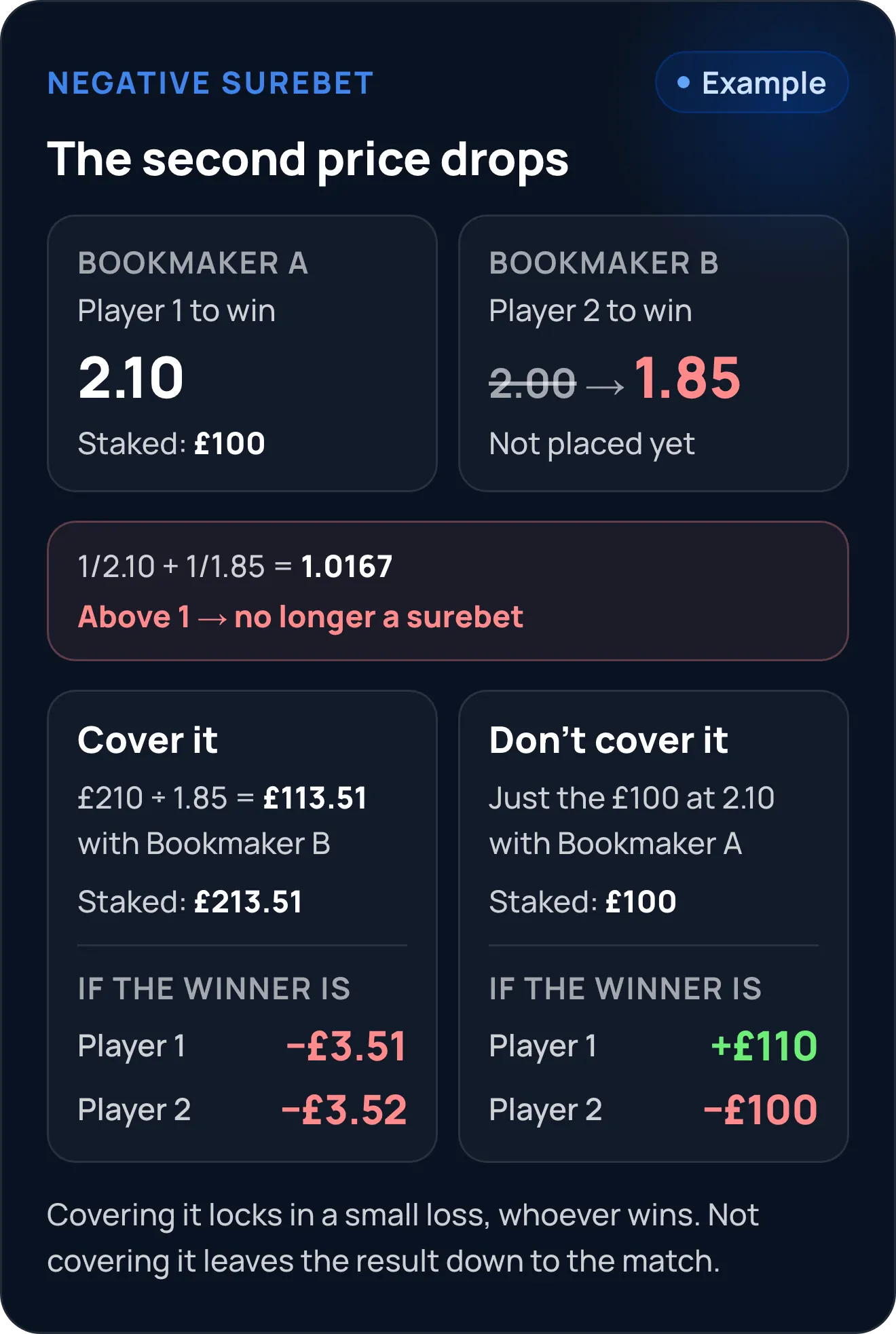
What is a negative surebet?
It means covering a bet that has been left on its own and accepting a small loss, when the odds at the second bookmaker no longer give a surebet. Example: you have £100 at 2.10 (it would return £210) and the other odds have dropped from 2.00 to 1.85. To get £210 back if the other player wins as well, you need £113.51: you stake £213.51 in total and lose about £3.51 whoever wins, instead of risking the £100. The other option is to let the bet run. Although BetOven places the value odds first, the bet left on its own is not a value bet: it can win or lose. In BetOven, closing at a small loss is a setting you switch on or off depending on your strategy.
Singlebets and how to close them in BetOven
What is the big downside of surebets?
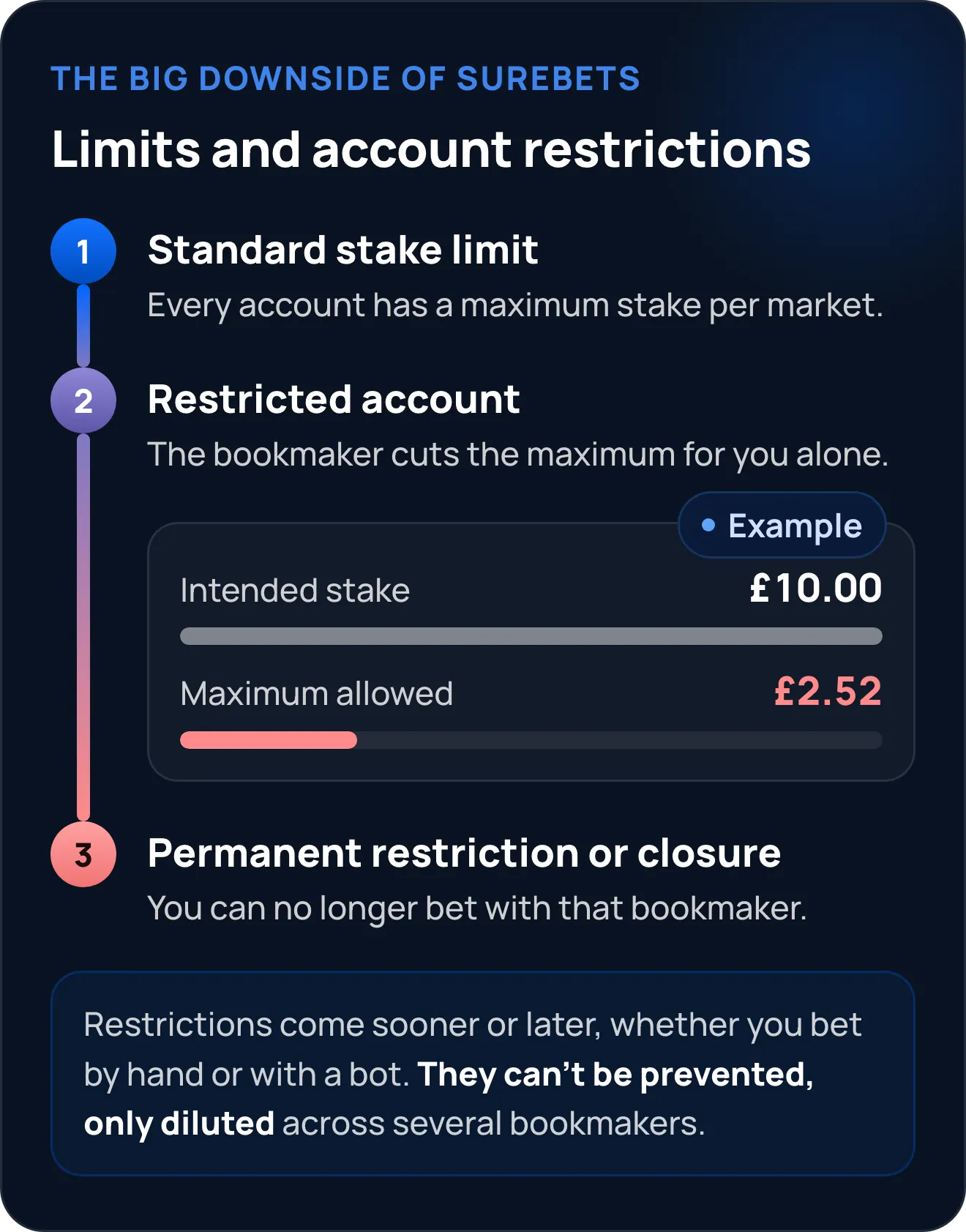
Bookmaker restrictions. Sooner or later, bookmakers restrict or close the accounts whose betting pattern they don’t want, and surebetting is exactly that kind of pattern, whether you bet by hand or with a bot. It may start with accepting smaller stakes or taking longer to accept your bets; at the extreme, the account is permanently restricted or closed. Bookmakers judge your betting pattern, not just your recent results. How is it managed? By starting with the value odds and, at a restricted bookmaker, looking for surebets where the value odds are at that bookmaker. Restrictions can’t be prevented, only diluted across several bookmakers: if one bookmaker closes your account, you carry on with the others, always with accounts in your own name.
Try BetOven, our surebet software, free with £25 in points
No card needed. It runs on Windows (on a Mac, with Parallels or on a remote server), and we help you install it over AnyDesk.
