
Closing Line
For years, the Closing Line has been the holy grail for many bettors who call themselves professionals.
They say that if you beat the market’s closing odds before the event starts, you have an edge.
And technically, they’re not wrong.
But there’s something most people don’t dare to say:
That model is no longer enough.
Because today, the real edge isn’t in anticipating the market… it’s in reacting faster than it.
Let’s break it all down in this article.

What exactly is the Closing Line?
The Closing Line is the final odds offered by the market just before a sporting event begins.
It reflects:
All the available pre-match information
All the movements made by bettors
All the adjustments made by bookmakers
In theory, it’s an efficient price.
And if you manage to place a bet at odds higher than the closing line, you’re getting “value.”
So far, so good.
But here’s the real issue:
that edge is minimal.
And it’s based on what might happen.
What happens to Closing line once the event starts?
This is where everything changes.
Once the match kicks off:
The players are already on the pitch.
Reality replaces statistics.
Bookmakers adjust odds in real-time based on what they see—but they don’t always do it well.
And this opens up a new playing field:
Live odds errors.
Small glitches, mismatches, and delays between bookies create real, not theoretical, value.
And that value has nothing to do with the Closing Line. It goes far beyond it.
The big difference: betting before the match VS exploiting in-game errors in the closing line
Many bettors work hard to find value before a match starts. And they do it well.
But they’re betting based on predictions, on models trying to estimate what might happen.
BetOven doesn’t predict. It detects.
While the match is being played, BetOven:
Analyzes odds from hundreds of bookmakers instantly
Detects real-time pricing discrepancies caused by in-game action
Places bets only when it finds a clear and measurable mathematical advantage
It doesn’t rely on expectations.
It relies on facts.
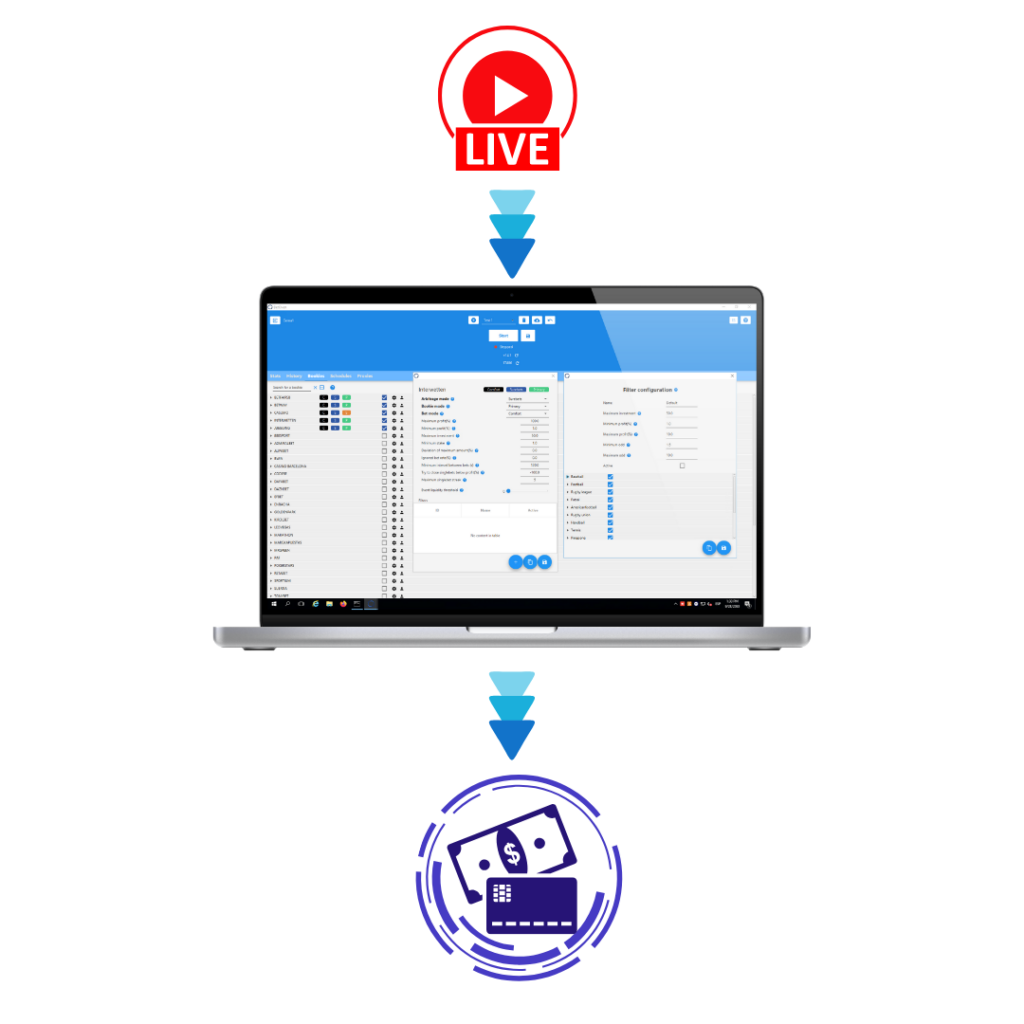
BetOven automatically finds opportunities like valuebets
A value bet happens when the actual probability of something happening is higher than what the offered odds suggest.
Example:
The fair odds (60% probability) should be 1.66
But the bookmaker, due to error or delay, offers you 1.90
That’s real value.
Mathematically, that bet is profitable in the long run.
Professional bettors don’t rely on gut feeling.
They search for, hunt down, and execute value bets.
Automate Valuebets for Free
BetOven doesn’t try to beat the Closing Line — it outperforms it by definition
While others obsess over getting 2.05 instead of the 2.00 that closes the market…
BetOven is betting at 2.40 odds that should be 2.00
Because it spotted a delay, an error, or a sluggish reaction from a bookmaker to what’s happening live.
It’s a different league.
And that’s why it makes no sense to measure it with old rules.
So, you might ask:
Who really has the edge?
– The one betting before the game, hoping to have predicted better than the market?
– Or the one betting during the game, with real-time data, exploiting errors that are actively happening?
The answer is obvious.
Betting before the event is playing chess.
Betting during, with AI, is playing with X-ray vision.

How does it work?
✅ Scans dozens of bookmakers and compares odds in milliseconds
✅ Assesses the real probability of an outcome by cross-referencing data between bookies, markets, trends, and its own algorithms
✅ Identifies mispriced odds—those paying more than they should
✅ Automatically places the bet as soon as it detects value—no human intervention needed
✅ Repeats this process hundreds of times per day, increasing volume and making the strategy scalable
What BetOven does is exploit the only structural weakness of bookmakers:
Temporary pricing errors.
Errors that, for a manual bettor, either go unnoticed—or come too late.
Alcuni risultati con la IA di BetOven
Se venivi a cercare picks, hai trovato una miniera d’oro! Guarda i risultati di alcuni cacciatori grazie a BetOven: