What does a red card mean in sports betting?
A red card in soccer means that a player is sent off from the match and their team must continue with one less player. In sports betting, this detail is not minor: a sending-off can completely change the course of the match and cause major movements in the odds.
When a team is left with 10 players, sportsbooks quickly adjust their markets. The odds change for the match winner, goals, handicaps, next goal, draw no bet, and many other live markets.
But the most interesting thing is not just that the odds change. What matters is that sometimes the market does not properly adjust to the real impact of that red card. And that is where value opportunities can appear.
What is a red card in soccer?
A red card is the most severe sanction a player can receive during a match. The referee shows it when they believe a serious offense has occurred, such as a dangerous tackle, violent conduct, a handball that prevents a clear goal-scoring opportunity, or a second yellow card.
When a player receives a red card:
- They must leave the field immediately.
- Their team cannot substitute them.
- The team plays the rest of the match with one fewer player.
- The tactical setup of the match changes.
- The betting odds are readjusted almost instantly.
That is why a red card does not only affect the game. It also directly affects the betting market.
Why does a red card change the odds so much?
Odds reflect probabilities. If a team had a 50% chance of winning before the sending-off, that probability can drop significantly if it loses an important player, especially if the red card comes early.
For example:
- If the favorite receives a red card in the 15th minute, their odds to win will probably rise.
- If the team that was losing goes down to 10 players, the opponent’s odds will drop.
- If the sending-off affects a center-back, the goals markets may move.
- If the red card comes in the 85th minute, the impact is usually smaller than if it comes in the 20th minute.
The key is understanding that not all red cards have the same value. An early sending-off is not the same as a stoppage-time sending-off. It is also not the same whether the red card is given to a goalkeeper, a defender, a central midfielder, or a forward.
Practical example of a red card in betting
Practical example of a red card in betting
Before the red card:
- Real Madrid wins: odds 1.60
- Draw: odds 4.00
- Valencia wins: odds 6.00
In the 25th minute, Real Madrid receives a red card.
After the sending-off, the odds could change like this:
- Real Madrid wins: odds 2.20
- Draw: odds 3.50
- Valencia wins: odds 4.20
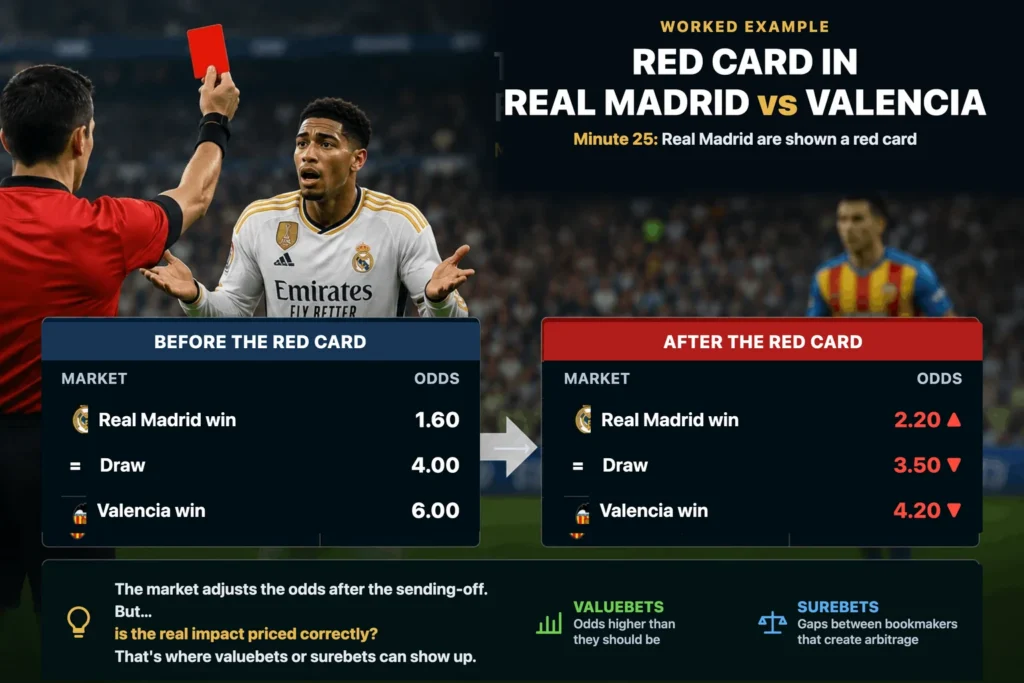
The market has reduced Real Madrid’s probability of winning and increased Valencia’s chances. But here is the important part: that adjustment may be correct, exaggerated, or insufficient.
If Real Madrid continues to dominate, has the lead on the scoreboard, and the sending-off does not affect its structure too much, perhaps the 2.20 odds are too high. In that case, there could be a value bet.
If, on the other hand, several sportsbooks react at different speeds and for a few seconds offer odds that are misaligned with each other, a surebet could appear.
Red card and live betting
Red cards are especially important in live betting because the market has to react in real time. In just a few seconds, sportsbooks must recalculate the probabilities of the match.
This creates a very dynamic environment. Odds can change several times in less than a minute, especially in markets such as:
- Match winner.
- Double chance.
- Draw no bet.
- Asian handicap.
- Total goals.
- Next goal.
- Exact score.
- Qualification or advancement to the next round.
- Total cards.
- Corner kicks.
The problem is that the manual bettor usually arrives late. By the time you see the red card, open the sportsbook, find the market, check the odds, and decide to place a bet, the value has probably already disappeared.
In live betting, speed matters.
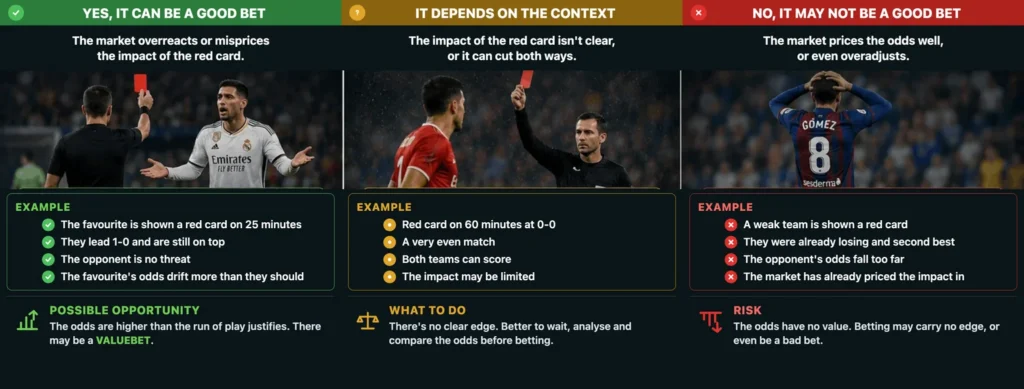
Does a red card always create a good betting opportunity?
No. This is one of the most common mistakes.
Many people think that when a team receives a red card, they should automatically bet on the opposing team. But that does not always make sense.
A red card may already be correctly reflected in the odds. It may even be overvalued by the market. If all bettors rush to bet against the team that had a player sent off, the opponent’s odds may drop too much and lose their value.
A good bet does not depend only on what happens on the field. It depends on whether the odds offered are higher than the true probability of the event.
Therefore, the right question is not:
“Which team benefits from the red card?”
The right question is:
“Are the current odds mispriced after the red card?”
That is the difference between betting on intuition and betting with positive expected value.
Factors to analyze after a red card
To properly interpret a sending-off, it is not enough to know which team is down to 10 players. You need to analyze the full context of the match.
Minute of the sending-off
A red card in the 10th minute has a huge impact. A red card in the 90th minute may have a very limited impact. The more time remains to be played, the more significant the effect of the sending-off will be.
Current score
Receiving a red card while leading 2–0 is not the same as receiving one while trailing 0–1. The team with a player sent off may sit back, reduce risks, and try to preserve the result.
Affected team
If the favorite receives the red card, the market usually reacts strongly. If the weaker team receives it, the adjustment may be smaller because the market already expected the opponent to dominate.
Position of the sent-off player
A red card for a defender can increase the risk of conceding goals. A red card for a forward can reduce the team’s attacking capability. A red card for the goalkeeper may force a complete change in the game plan.
Style of play
Some teams know how to defend very well with one player less. Others become completely disorganized. The tactical impact depends heavily on the team’s profile.
Physical and emotional condition
A sending-off can mentally disrupt a team. It can also trigger a strong defensive response. The psychological context of the match influences more than it may seem.
Market reaction
⚠️ This is the most important factor for the bettor. It is not enough to know that the red card changes the match. You need to know whether the odds have moved too much, too little, or in the wrong direction.
Red cards and value bets
A value bet appears when the odds are higher than they should be according to the true probability of the event.
After a red card, value bets can appear because sportsbooks have to adjust many markets immediately. In that process, they can make mistakes.
Example:
A favorite receives a red card in the 30th minute but is still leading 1–0, maintains control of the match, and the opponent is barely creating any danger. The sportsbook increases its odds from 1.70 to 2.40.
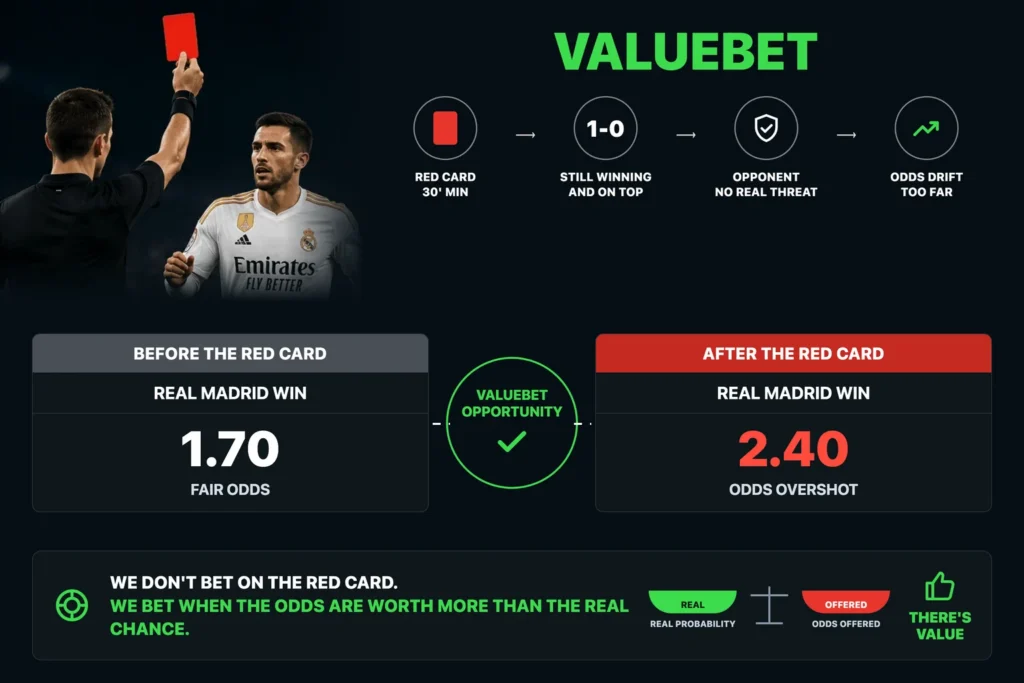
If a proper analysis indicates that this team still has a better chance of winning than the odds imply, we may be looking at a value bet.
The opportunity is not in betting “because there was a red card.” The opportunity is in identifying that the odds have moved too far.
Red cards and surebets
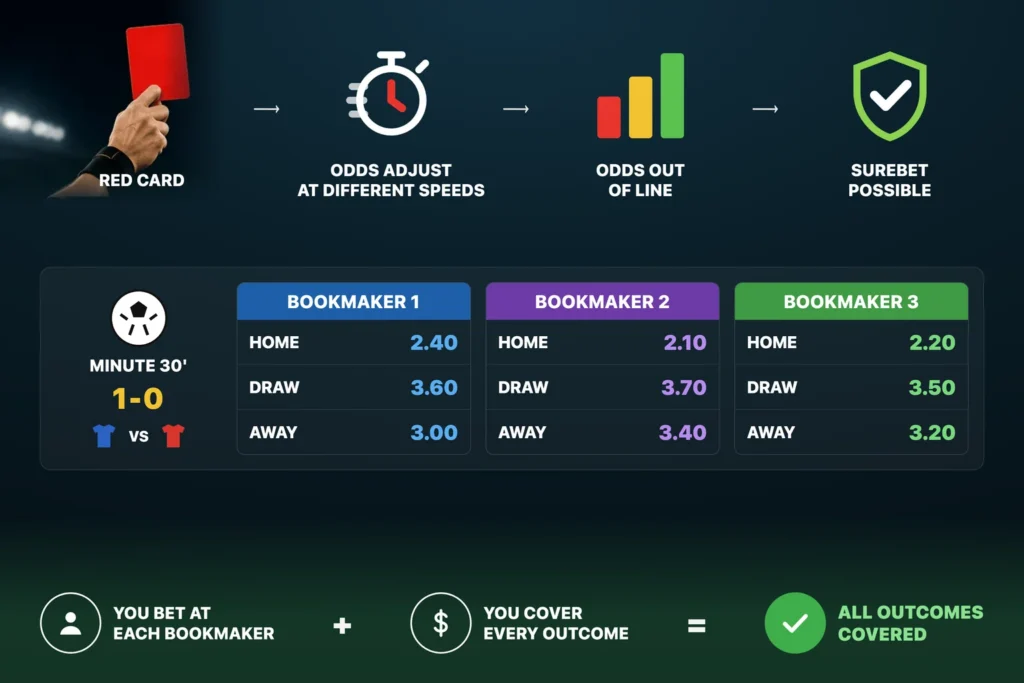
A surebet appears when the odds offered by different sportsbooks allow all possible outcomes to be covered and a profit to be secured regardless of the final result.
Red cards can generate surebets because not all sportsbooks update their odds at the same speed. Some react first. Others take a few more seconds. In live markets, those seconds can create exploitable discrepancies.
For example, after a sending-off:
- One sportsbook quickly lowers the odds on the team with the numerical advantage.
- Another sportsbook still keeps the old odds.
- A third sportsbook incorrectly adjusts the draw or the handicap market.
If the odds become unbalanced across different sportsbooks, an arbitrage opportunity may arise.
The problem is that these opportunities usually last for a very short time. Therefore, detecting them manually is extremely difficult.
Can you bet manually after a red card?
Yes, it can be done. But it is not easy to do it well.
The manual process would look something like this:
1. See the red card live.
2. Quickly understand how it affects the match.
3. Check several sportsbooks.
4. Compare odds across different markets.
5. Calculate whether there is real value.
6. Place the bet before the odds disappear.
All of this should be done within seconds. And that is the big problem.
Most bettors do not lose because they do not know that a red card is important. They lose because they arrive too late, bet impulsively, or do not calculate whether the odds actually offer value.
Common mistakes when betting after a red card
Always betting against the team that had a player sent off
This is the most typical mistake. Just because a team has one fewer player does not automatically mean that the opponent offers value.
Confusing an odds movement with an opportunity
The fact that odds go up or down does not mean they are good. It only means that the market has reacted.
Entering too late
In live betting, value odds may last only seconds. If you enter after the market has already corrected the price, the value has probably disappeared.
Ignoring the context of the match
A red card is not interpreted the same way in every match. The minute, the score, the player’s position, and the playing style of both teams are key factors.
Betting on emotion
Red cards create tension. And tension often leads to poor decisions. Betting impulsively after a sending-off can be very dangerous.
How BetOven can help you in red card situations
BetOven is not designed for you to watch a match, see a red card, and rush to place a manual bet. Its function is much more powerful: to analyze odds in real time and detect mathematical discrepancies between sportsbooks.
When an important event such as a red card occurs, the market moves quickly. During that movement, the following may appear:
- Overpriced odds.
- Discrepancies between sportsbooks.
- Poorly adjusted markets.
- Temporary value bets.
- Very short-lived surebets.
BetOven automatically scans multiple sportsbooks and looks for real opportunities based on value bets and surebets. In other words, it does not place bets because there was a red card. It places bets when it detects that an odd has a mathematical edge or that there is an exploitable arbitrage opportunity.
That difference is key.
A red card can be the trigger. But the real opportunity lies in the pricing error.
Red card: example of a misunderstood opportunity
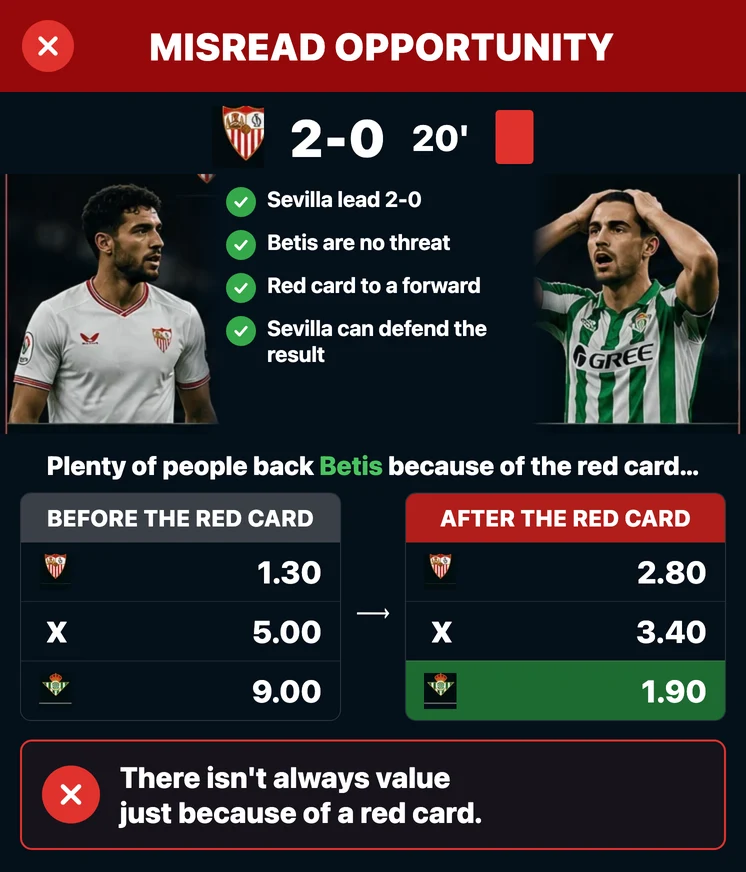
Suppose Sevilla receives a red card in the 20th minute against Betis. Many bettors would think: “Now we have to bet on Betis.”
But imagine this context:
- Sevilla is leading 2–0.
- Betis is not creating clear chances.
- The player sent off is a forward.
- Sevilla can switch to defending in a low block.
- Betis’s odds drop too much due to the market’s emotional reaction.
In that case, betting on Betis may not offer value. Depending on the odds, it could even be more valuable to bet that Sevilla holds on to the result.
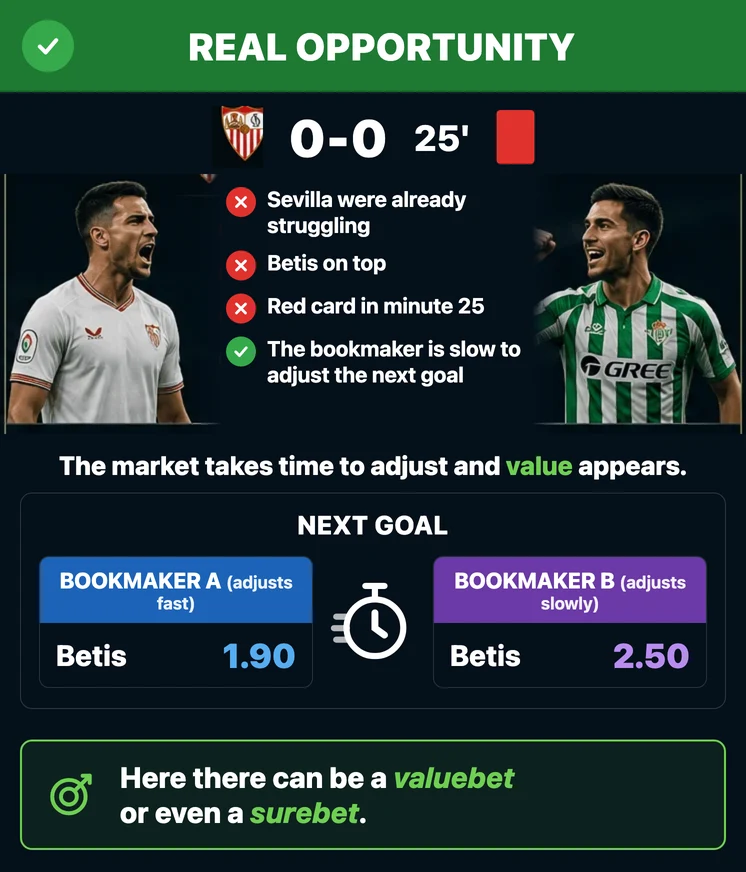
Ahora imagina el caso contrario:
- The team that receives the red card was already struggling.
- The red card comes in the 25th minute.
- The opponent was dominating the match.
- The sportsbook is slow to adjust the next-goal market.
- Another sportsbook keeps outdated odds for a few seconds.
That is where a real opportunity could appear.
Therefore, in sports betting, it is not enough to know what happened. You also need to understand how the market has interpreted it.
Does it make sense to bet on red cards?
Betting directly on whether there will be a red card is a very specific and difficult market. Sendings-off are not as common as other events in a match, and they often depend on factors that are difficult to predict: refereeing decisions, tension, rivalry, isolated challenges, or last-man situations.
It can make sense to analyze card markets if you study:
- The match referee.
- The rivalry between the teams.
- Disciplinary history.
- Defensive style.
- The importance of the match.
- Players prone to committing fouls.
- Competitive context.
Even so, betting on red cards is usually not the simplest path to seeking consistent profitability. For most bettors, it is more interesting to understand how a red card affects other markets and how it can generate pricing errors.
Conclusion: a red card is not a bet, it is a market signal
A red card can change a match. But in sports betting, what matters is not just the sending-off. What matters is how the odds react.
Betting simply because a team has gone down to 10 players is an overly simplistic strategy. Profitability appears when you identify that the market has miscalculated the impact of that sending-off.
That’s where concepts like valuebets, surebets, and live bets with a mathematical edge come in.
BetOven is designed precisely for that: scanning odds in real time, detecting discrepancies, and finding opportunities that a manual bettor would find difficult to spot in time.
Because a red card can open a window of opportunity.
But only those who measure the true value of the odds know whether it is worth getting involved.
Frequently asked questions about red cards in sports betting
¿Qué significa tarjeta roja en apuestas?
It means that a player has been sent off and their team will play with one fewer player. In betting, this usually causes immediate changes in the match odds.
Does a red card void a bet?
Normally not. A red card is part of the normal course of a match. Bets remain active unless the specific rules of the market or sportsbook state otherwise.
Is it profitable to bet after a red card?
It can be if the odds are mispriced. But it is not profitable to automatically bet against the team that had a player sent off. You need to analyze whether there is real value.
Which markets change the most after a red card?
The most affected markets are usually match winner, handicap, total goals, next goal, double chance, and correct score.
Does a red card always benefit the opposing team?
Not always. It depends on the minute, the scoreline, the player sent off, the style of play, and the tactical reaction of the affected team.
Can value bets appear after a red card?
Yes. A value bet can appear if the sportsbook overestimates or underestimates the real impact of the sending-off.
Can surebets appear after a red card?
Yes. Surebets can appear when different sportsbooks adjust their odds at different speeds after the sending-off.
Does BetOven automatically place bets after a red card?
BetOven does not place bets simply because there has been a red card. Its goal is to detect value odds or discrepancies between sportsbooks. If a red card creates a real opportunity, BetOven can detect it much faster than a manual bettor.