Free Trial

Kelly Criterion Betting: Formula, Examples, Pros and Cons


Kelly criterion betting is a way of deciding how much of your bankroll to put on each bet, based on the edge you have: Kelly = (p × odds − 1) / (odds − 1), where p is the true probability of the bet winning and the odds are decimal. If the result is negative, you don’t bet; if it’s positive, in practice you stake only part of it, somewhere between a quarter and a half. It’s risk management: it doesn’t tell you what to bet on, only how much.

This article didn’t come out of a textbook. A client who had started with arbitrage betting and was weighing up a move to value bets kept telling us that BetOven should size every bet with Kelly. We put it to José Antonio, BetOven’s co-founder and the author of its algorithm, and he walked the team through it at a meeting in September 2026.

It was set out by John L. Kelly Jr., a researcher at Bell Labs, in 1956 (you’ll also see it called the Kelly formula or Kelly staking), and it answers one specific question: if you have an edge on a bet, how much should you stake? Stake too little and the edge barely shows; stake too much and an ordinary losing run sinks your bankroll.

Kelly = (p × odds − 1) / (odds − 1)

p is the true probability of the bet winning and the odds are the decimal price the bookmaker pays. The result is the fraction of your bankroll you’d stake. It’s the same as edge / (odds − 1).

You’ll also see the classic form, (b × p − q) / b, with b = odds − 1 and q = 1 − p. It’s the same formula, and it suits fractional odds, because b is simply the fraction: at 21/20, b = 1.05.

An illustrative example, with a true probability of 50% and odds of 2.05 (21/20):

  1. Edge: 0.50 × 2.05 − 1 = 0.025, or 2.5%.
  2. Kelly: 0.025 / 1.05 = 0.0238, or 2.38% of your bankroll.
  3. In pounds, with a £1,000 bankroll: £23.81 at full Kelly, £11.90 at half Kelly and £5.95 at quarter Kelly.

Kelly doesn’t create value: if the bet doesn’t have a positive expected value, it comes out at zero or below. At odds of 1.90 (9/10) it would give −5.56%. That doesn’t mean ‘bet the other side’: it means you don’t bet.

Where the probability comes from: the fair odds

Plenty of guides simply make it up (‘you think the team has a 55% chance’). In value betting, you take it from the market, from the prices at the lowest-margin bookmakers:

  1. Reference odds: a tennis match priced at 1.95 (19/20) for each player. 1 / 1.95 = 51.28% per player; between the two, 102.56%. The extra 2.56% is the bookmaker’s margin, or overround.
  2. Remove the margin: 51.28 / 102.56 = 50%, so the fair odds are 2.00, or evens. If the prices on each side differ, the margin is shared out proportionally, as you’ll see in our guide to odds comparison software.
  3. Compare: if another bookmaker pays 2.05, the edge is 2.05 / 2.00 − 1 = 2.5%, the one from the example.

That’s a value bet: odds longer than the fair price. And the probability Kelly needs is 1 / fair odds: a market price, not your opinion of the match. That doesn’t make it exact, as you’ll see in the cons.
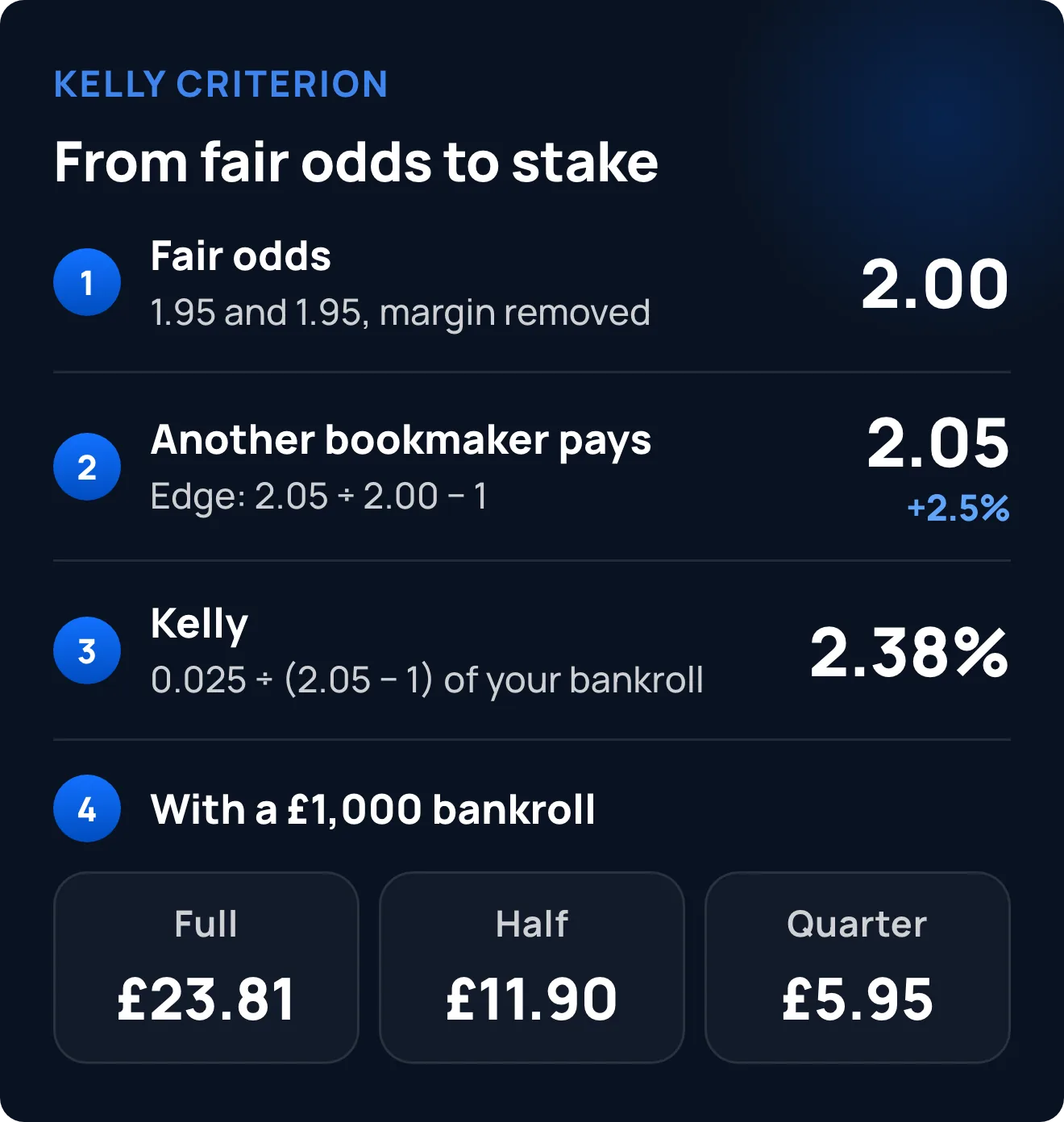
Kelly worked out step by step: fair odds of 2.00, another bookmaker pays 2.05 (a 2.5% edge), Kelly of 2.38% of the bankroll and, with £1,000, £23.81 at full Kelly, £11.90 at half and £5.95 at quarter

From the market price to the stake, using the tennis example.

Kelly criterion examples with four value bets

Worked calculations, not a forecast:

OddsFair oddsValue (edge)Full KellyQuarter Kelly
1.50 (1/2)1.453.45%6.90%1.72%
1.70 (7/10)1.606.25%8.93%2.23%
2.10 (11/10)1.957.69%6.99%1.75%
3.50 (5/2)3.209.38%3.75%0.94%

The 3.50 bet has the most value and, even so, Kelly gives it less than half of what it gives the 1.70: more value means a bigger stake, but longer odds mean a smaller one, because a price of 3.50 comes in less than one time in three and losing runs get longer.

How much to bet: why level stakes and a fixed percentage fall short

José Antonio started with the two methods almost everyone uses (the meeting was in Spanish, so his words here are translated):

  • Level stakes. If you start at £50 a bet and your bankroll doubles, each bet is only half the share of your bankroll it was at the start; if the bankroll falls, you’re risking the same amount on less money.
  • A fixed percentage, say 10% of your bankroll. It’s the quick rule everyone quotes: it moves with the bankroll, but it hides a trap.

Then there are progressions such as the Martingale, which raise the stake after every loss without checking whether there’s any value: that isn’t bankroll management.

The volatility trap: the coin example

José Antonio explained it like this: with too high a percentage you can lose in the long run even with an edge, because gains and losses multiply rather than add up. If £1,000 goes up 10% (£1,100) and then down 10%, you’re left with £990, not £1,000.

His example: an ordinary coin that pays odds of 3.00 (2/1) on heads. For every £1, you win £2 or lose £1: a huge edge, 50%. If you stake 10% of your bankroll, heads lifts it by 20% and tails takes 10% off. If you stake 60%, heads lifts it by 120% and tails takes 60%: £1,000 becomes £2,200 and then £880.

This is a theoretical example. No real bet has an edge anywhere near this, so the figures in the table aren’t an expectation of anything: they’re there to show the shape of the curve.

In theory, this is what would happen to the bankroll in a typical run of 100 tosses, depending on the share you stake on each:

Share of the bankroll on each tossBankroll after 100 tosses (theoretical coin: 50 heads, 50 tails)
10%× 46.9
25% (Kelly)× 361
40%× 46.9
50%× 1: no progress despite the edge
60%× 0.0017: wiped out despite the edge

Past 25%, staking more only adds risk: 40% ends up in the same place as 10%, with bigger swings, and 60% wipes you out. If you work out where that point lies, you get a fraction that changes with every bet: it depends on the probability of winning, the probability of losing and the odds. That’s the Kelly criterion. For the coin, with the formula from the start, (0.5 × 3.00 − 1) / (3.00 − 1) = 25%. Think of Kelly as a ceiling, not a target.
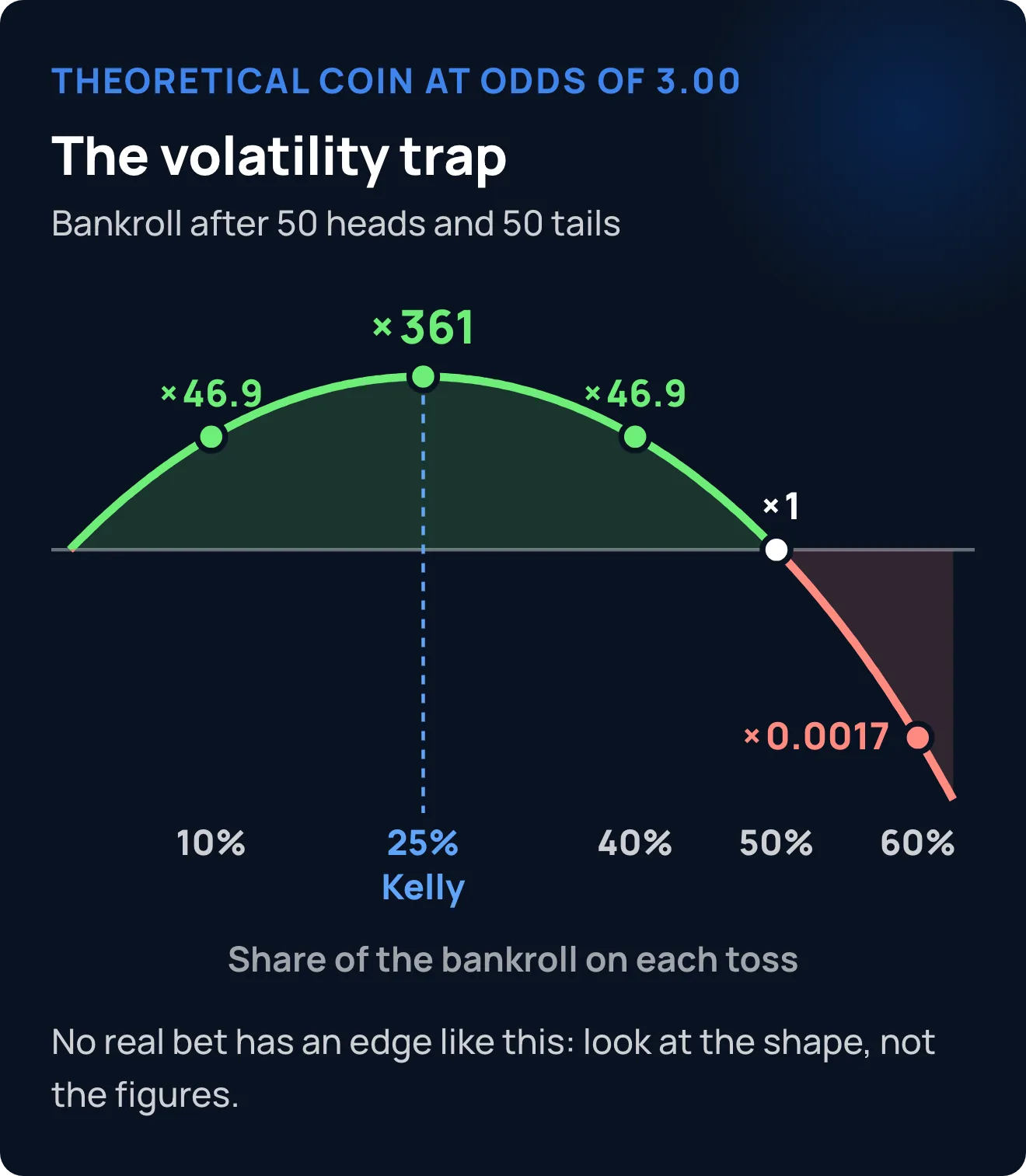
Curve for the theoretical coin at odds of 3.00: after 50 heads and 50 tails, the bankroll is multiplied by 46.9 staking 10%, by 361 at 25% (Kelly), by 46.9 at 40%, by 1 at 50% and by 0.0017 at 60%

Green: the bankroll grows; red: it shrinks. The peak is at 25% (Kelly).

Fractional Kelly: full, half and quarter Kelly

Even with the edge measured correctly, full Kelly swings hard, so people who use it usually stake a fraction. With the tennis example and a £1,000 bankroll:

FractionStake per betTheoretical pace compared with full Kelly (if the edge is real)Theoretical chance of seeing the bankroll halve
Full Kelly£23.81The benchmarkAround 50%
Half Kelly£11.90About three quartersAround 12.5% (one in eight)
Quarter Kelly£5.95A little under halfUnder 1%

These are theoretical figures. José Antonio puts it this way: Kelly can help you avoid losing so quickly on value bets and, if you only stake a fraction of it, what slows you down in bad runs also slows you down in good ones. ‘It isn’t magic.’

A practical benchmark: 1% to 5% of your bankroll

Ours is simple: each bet should put between 1% and 5% of your total bankroll at stake. We often see users who set stakes far too high for their bankroll and who, once they hit a losing run, don’t recover. In the four value bets above, quarter Kelly sits almost entirely inside that band, and full Kelly is above it in three of them.

Watch the top of the band, though: with a small edge or long odds, 5% can be more than double Kelly (in the tennis example, double Kelly is 4.76%), and then, in theory, the bankroll shrinks over time. With value bets, stay at the lower end.

Don’t confuse this with the 1-to-10 stakes tipsters use, which measure their confidence in a tip, not an edge you can calculate (there’s more in what stake means in betting).

Pros and cons of the Kelly criterion

‘Mathematically it’s excellent, but it’s hard to put into practice,’ is how José Antonio sums it up.

What Kelly has going for it

  • A rule, not a hunch: the stake comes from the edge and the odds, and when there’s no value it tells you not to bet.
  • It moves with your bankroll: if the bankroll falls, the stake falls with it, so in theory you never reach zero.
  • It spreads the money sensibly: more on what has more value and less on longer odds, which are the ones that swing most.

What counts against it

  • It needs the exact probability. With value bets, that comes from the fair odds, which are an estimate. The prudent approach is to assume the worst case, and that means staking less than the formula asks for.
  • It spreads the error, too. Putting more money on the bet that ‘seems’ to have more value only helps if that difference is real; if much of it is estimation error, you add swings and nothing else. It’s the practical side of José Antonio’s warning that the value is only ever an approximation.
  • It recovers slowly: when you lose, you stake less each time, and climbing out of a dip takes a while.
  • It assumes you can stake whatever you like. Where Kelly asks for a big stake, the bookmaker caps it and you stake less than calculated. ‘That’s where the criterion breaks down,’ says José Antonio. We’d put it more precisely: rather than breaking down, it loses much of its advantage. By Kelly’s own logic, staking the maximum the bookmaker allows is still the right call on that bet, but you can no longer put more where there’s more value, which is the whole point of Kelly.
  • It thinks in terms of one bankroll and one bet after another (we’ve added this one; it affects any way of sizing stakes, BetOven’s included): your money is spread across several bookmakers, and you often have several bets open at once.

The biggest drawback, in numbers

In the tennis example (odds of 2.05 and a true probability of 50%), this is what happens if you overestimate the probability slightly:

Probability you believeFair odds you assumeKelly you getWith a £1,000 bankrollCompared with the right stake
50% (the true one)2.002.38%£23.81The right stake
52%1.926.29%£62.862.6 times as much
55%1.8212.14%£121.435 times as much

Fair odds of 1.92 instead of 2.00 is a small error, and you’re already staking 2.6 times what you should. Stake around twice what Kelly says and, in the long run, your bankroll stops growing even with an edge; stake more than that and it shrinks. The fraction protects you: quarter Kelly while believing 55% would be £30.36, well short of the £47.62 of double Kelly.
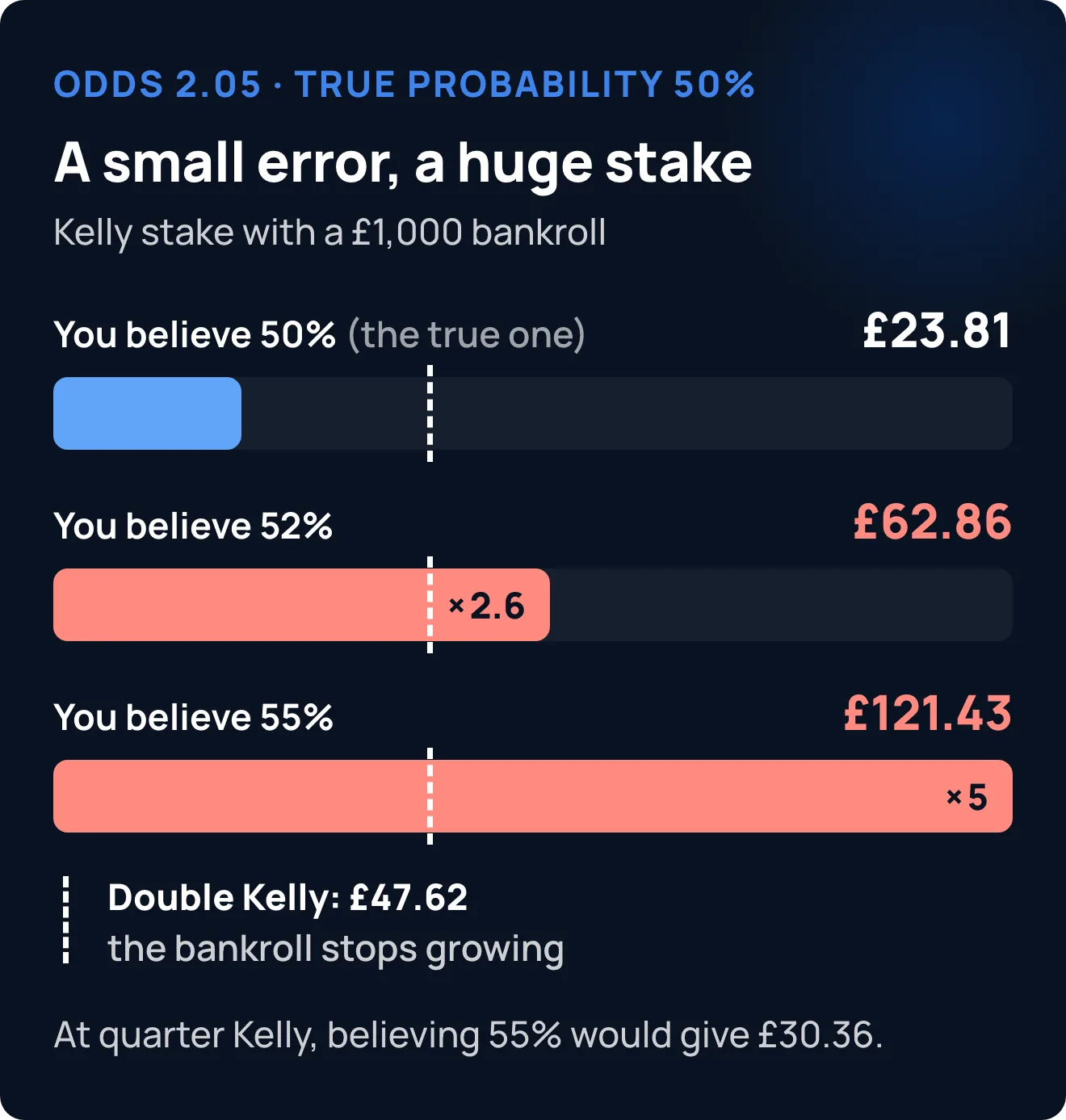
Kelly stake with a £1,000 bankroll depending on the probability you believe: £23.81 at the true 50%, £62.86 at 52% and £121.43 at 55%, against £47.62 for double Kelly

At double Kelly the bankroll stops growing; past it, it shrinks even with an edge.

Kelly vs a maximum profit per bet (what BetOven does)

BetOven doesn’t use the Kelly criterion: according to José Antonio, its value bet mode doesn’t need it. It works with a maximum profit per bet, which you set. Despite the name, it isn’t your profit: it’s the total you get back if the bet wins, stake included (odds × stake), which bet slips usually call potential returns. So the stake is the maximum profit divided by the odds: if the bet wins, you get the same back whatever the odds, and what you risk falls as the odds get longer. For example, with £30, at odds of 1.50 you stake £20 and, if it wins, you get £30 back (£10 more than you staked); at 3.50 you stake £8.57 and, if it wins (less than one time in three), you get the same £30 back (£21.43 more than you staked). If it loses, you lose your stake: £20 or £8.57.

That isn’t Kelly. Kelly sizes the stake as a share of your bankroll, edge ÷ (odds − 1); BetOven multiplies the maximum profit by 1 ÷ odds (the probability implied by the odds themselves) and doesn’t look at the estimated value to decide the stake.

The same four value bets under both rules

An example, not a forecast: the stake on each bet with a £1,000 bankroll, at quarter Kelly and with a maximum profit of £30 (3% of the bankroll), so each BetOven stake is £30 ÷ odds.

OddsFair oddsValueQuarter Kelly stakeBetOven stake (maximum profit £30)
1.50 (1/2)1.453.45%£17.24 (1.72%)£20.00 (2.00%)
1.70 (7/10)1.606.25%£22.32 (2.23%)£17.65 (1.76%)
2.10 (11/10)1.957.69%£17.48 (1.75%)£14.29 (1.43%)
3.50 (5/2)3.209.38%£9.38 (0.94%)£8.57 (0.86%)
Total staked£66.42£60.51

Disclosure: BetOven is our own software. We include it here to show how its rule differs from Kelly, not to score one against the other.

Taken together, the two stake similar amounts; what changes is the split. Compared with BetOven, Kelly puts more on the three with the most estimated value (£22.32 against £17.65 on the 1.70) and less on the one with the least (£17.24 against £20.00 on the 1.50). BetOven doesn’t look at the value when it sets the stake, so an error in that value doesn’t move it. And the swings are similar: the typical swing on each bet, win or lose, is around £14-15 in all four, against £12-18 with quarter Kelly. That’s how it smooths out volatility. If the value were exact, Kelly would make more of the bets with more value.
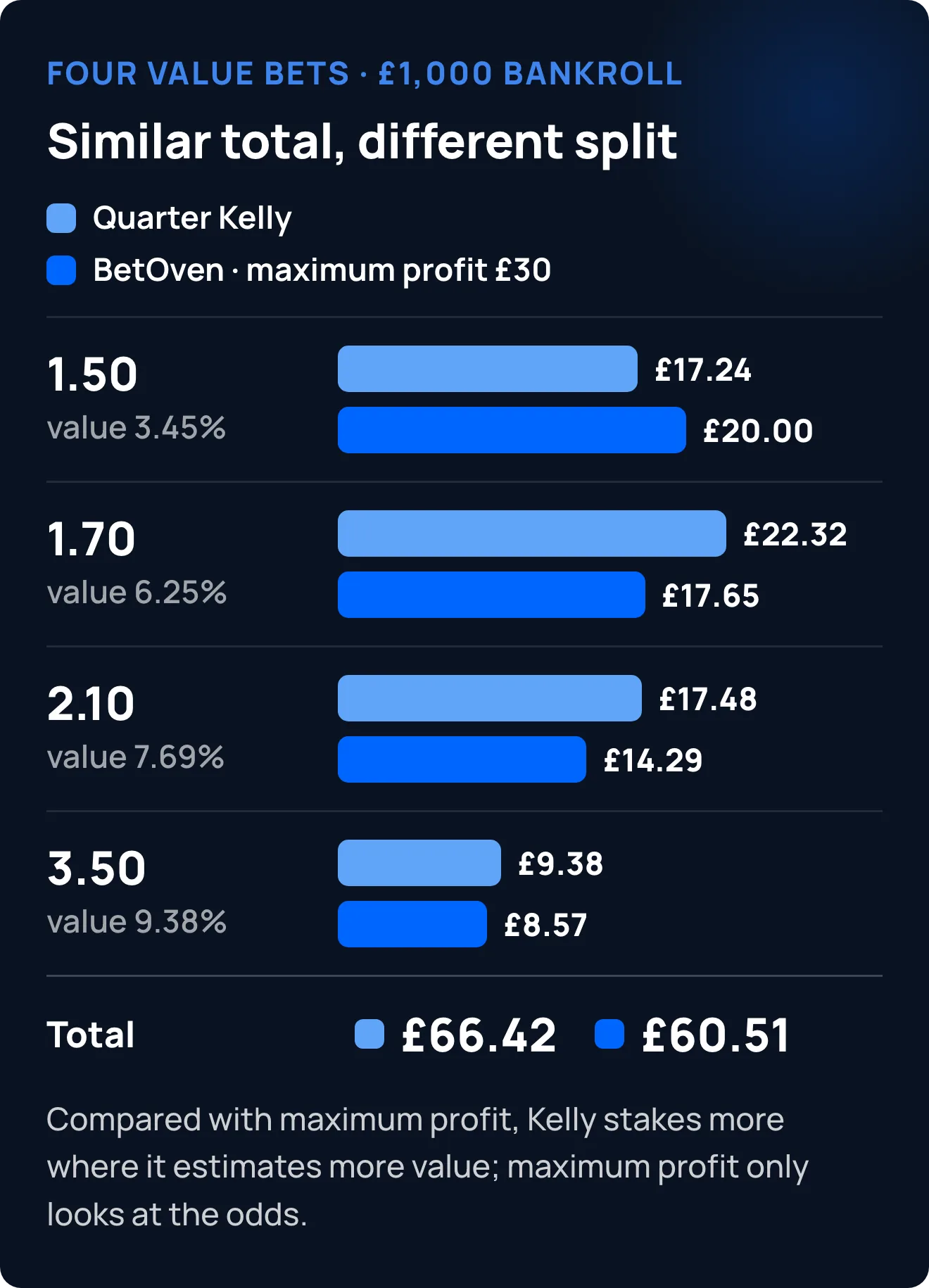
Stake on four value bets with a £1,000 bankroll: quarter Kelly puts £17.24, £22.32, £17.48 and £9.38 (£66.42 in total) and BetOven, with a £30 maximum profit, £20.00, £17.65, £14.29 and £8.57 (£60.51)

Worked examples at odds of 1.50, 1.70, 2.10 and 3.50: the totals are similar; what mainly changes is the split.

Turning the 1-5% into a maximum profit (a rough guide): with a maximum profit of between 2% and 5% of your bankroll, the stake (maximum profit ÷ odds) works out at between 1.33% and 3.33% of the bankroll at odds of 1.50, between 1% and 2.5% at 2.00 and between 0.57% and 1.43% at 3.50: inside the band or below it. With value bets, the lower end is better. And when your bankroll changes, recalculate the maximum profit: BetOven doesn’t adjust it for you.

Who was right, the client or José Antonio? Both

The client, in theory. With the exact probability, Kelly is the mathematically optimal way to size stakes over the long run, and the instinct behind the request points to two real things: putting more where there’s more value, and matching the stake to the bankroll.

José Antonio, in practice. The probability is an estimate and bookmakers cap stakes. To that we’d add that full Kelly is too aggressive and that in arbitrage, where the client was coming from, Kelly doesn’t apply.

The conclusion we reached with him wasn’t ‘ours is better’: it isn’t that one gets better results; each one carries less risk in different circumstances.

  • Kelly protects you better when your bankroll falls, because it cuts the stake by itself. With BetOven, if your bankroll falls, each bet takes up a bigger share of what you have left until you lower the maximum profit; lowering it is also the most direct way to reduce volatility.
  • The maximum profit protects you better when the probability is misjudged: it caps what each bet returns if it wins, you set it, and a calculation error doesn’t move it.

If you're coming from arbitrage and thinking about value bets

Kelly isn’t used in arbitrage betting (surebets). When every bet goes through, you cover every outcome and the odds set the stake on each side: with £100 on a tennis match at 2.10 (11/10) and 2.05 (21/20), £49.40 goes on the player at 2.10 and £50.60 on the one at 2.05, whatever staking plan you follow. You decide how much to put through in total, depending on the balance at each bookmaker and the chance that the second bet isn’t accepted at its price, as our guide to live arbitrage betting explains. Bookmakers can also limit accounts that bet this way; spreading your betting across several licensed bookmakers doesn’t stop any one of them from doing so.

With value bets, every single bet can lose, and the result only shows over many of them. That’s why, in BetOven, we recommend starting with the arbitrage mode, which is less volatile, and leaving the value bet mode to people with value betting experience. If you make the move:

  1. Start cautiously: between 1% and 5% of your bankroll per bet, preferably at the lower end; in BetOven, a maximum profit at the lower end of 2-5% of your bankroll.
  2. If you use Kelly, stake a fraction of it (a quarter) and use the most conservative probability: if in doubt, the longer fair odds.
  3. Count what you already have at stake: with several bets open, cut each one down, and check the balance at each bookmaker (in the UK, only use UKGC-licensed ones).
  4. Set deposit limits: UKGC-licensed bookmakers have to offer them, and they turn the bankroll you planned into a hard ceiling.
  5. Keep a record and track your yield: that’s what will tell you whether your edge is what you think it is. And expect losing runs even when you do everything right.
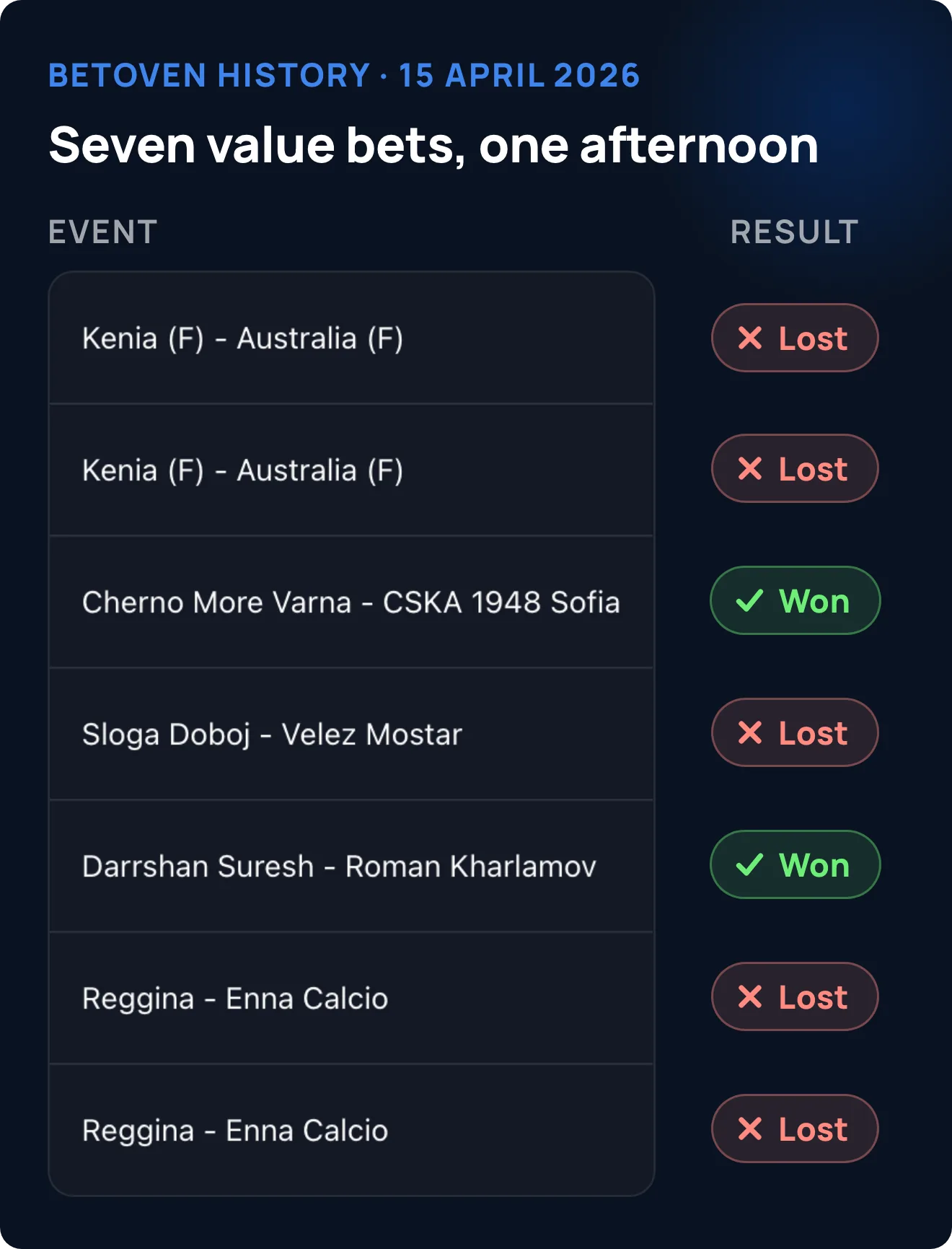
Real BetOven history of seven value bets settled in one afternoon, each marked lost or won: five were lost and two were won

Value bets BetOven settled on one profile on the afternoon of 15 April 2026 (event names as shown in the Spanish interface). One afternoon proves nothing: the result only shows over hundreds of bets.

If you want to keep placing bets yourself, the BetOven Scanner is free, runs on Windows and macOS and compares odds in-play to flag arbitrage and value bets; you choose the stake and place the bet. If you’d rather not do it by hand, BetOven finds them in-play and places the bets on your own accounts at several licensed bookmakers, with the maximum profit you set, while your Windows PC or a server is running (more on how BetOven works); your part is to check balances and bookmakers.

Free trial
How the BetOven trial works
  1. Request the trialNo card needed. For people with value betting or arbitrage experience.
  2. We set it up with youOver AnyDesk: installation, bookmakers and filters. It runs on a Windows PC or a server that stays on.
  3. BetOven places the betsIt finds arbitrage (surebets) and value bets in-play and places the bets on your own accounts.
Includes £25 in points
Worth knowing: bets are placed from your own balance and you can lose money, including during the trial. BetOven does not prevent bookmakers from limiting your accounts.

Kelly criterion in sports betting: FAQs

Does the Kelly criterion work in sports betting?

In theory, yes, if the edge is real and properly measured. In practice, the probability can only be estimated, it recovers slowly after losses and bookmakers cap stakes; that’s why people who use it usually stake a quarter or a half of what the formula asks for.

What Kelly fraction should I use?

Between a quarter and a half: a quarter while you don’t have a long record, and a half once that record backs up your edge. Without a reliable probability, use a small percentage of your bankroll instead, at the lower end of the 1-5% band.

Is there a Kelly criterion calculator? How to work it out in Excel

You don’t need a dedicated Kelly criterion calculator: one formula in Excel does the job. Put the probability in B2 (or =1/F2, with the fair odds in F2), the decimal odds in C2, your bankroll in D2 and your Kelly fraction in E2. The formula =MAX(0,(B2*C2-1)/(C2-1))*D2*E2 gives you the stake in pounds, and zero when there’s no value: with 0.50, 2.05, 1000 and 0.25, it returns £5.95. If your bookmaker shows fractional odds, convert them first (decimal odds = fraction + 1, so 21/20 becomes 2.05).

Can you lose money using the Kelly criterion?

Yes. Kelly decides the size of the bet, not the result: you can have losing runs even when your edge is real, and if the edge doesn’t exist, the formula won’t create it. What it does do is cut the stake when the bankroll falls, and that reduces the risk of running it down to nothing.

Does BetOven use the Kelly criterion?

No. BetOven works with a maximum profit per bet, which you set: the total you get back if the bet wins, stake included (odds × stake). The stake is that amount divided by the odds, so it puts less money on longer odds and more on shorter ones. Kelly also puts less on longer odds, but on top of that it stakes more where it estimates more value and adjusts to your bankroll by itself. Neither is better across the board: each one carries less risk in different circumstances.

18+ only. Please gamble responsibly. For free, confidential support 24/7, call the National Gambling Helpline on 0808 8020 133.

Prueba gratuitaProva gratuitaFree trial
Así funciona la prueba de BetOvenCome funziona la prova di BetOvenHow the BetOven trial works
  1. Pides la pruebaRichiedi la provaRequest the trialSin tarjeta. Necesitas un PC con Windows o un servidor, y saldo repartido en varias casas con licencia en España.7 giorni, senza carta di credito. Servono un PC Windows o un server e conti su più bookmaker con concessione ADM.No card needed. For people with value betting or arbitrage experience.
  2. La configuramos contigoLa configuriamo insieme a teWe set it up with youPor AnyDesk: instalación, casas y filtros. Academia incluida.Via AnyDesk: installazione, bookmaker e filtri. Corso BetOven Start incluso.Over AnyDesk: installation, bookmakers and filters. It runs on a Windows PC or a server that stays on.
  3. BetOven apuesta en tus cuentasBetOven piazza le giocateBetOven places the betsDetecta surebets y valuebets en directo y apuesta en varias casas en paralelo.Individua surebet e valuebet e piazza le giocate sui tuoi conti, su più bookmaker insieme.It finds arbitrage (surebets) and value bets in-play and places the bets on your own accounts.
Incluye 25 € en puntosInclude 2.500 puntiIncludes £25 in points
Conviene saberlo: apuestas con tu propio saldo, así que puede haber días en negativo. Y las casas limitan antes o después: cuando una lo hace, añades otra y sigues operando. La limitación no se elimina, se diluye.Meglio saperlo: operi con il tuo saldo e puoi perdere denaro, anche durante la prova; nessun risultato è garantito. I bookmaker possono limitare i conti e BetOven non lo impedisce.Worth knowing: bets are placed from your own balance and you can lose money, including during the trial. BetOven does not prevent bookmakers from limiting your accounts.
Panel de BetOven · historialBetOven · bookmaker attivi
Recorte del historial del panel web: en estas dos surebets, BetOven colocó una apuesta a cada resultado en dos casas distintas.Ritaglio della configurazione di un profilo: i bookmaker collegati su cui opera BetOven.

Sigue leyendoContinua a leggereKeep reading

FREE TRIAL · NO CARD NEEDED

The bot that bets for you

It finds and places value & sure bets for you, in real time. Stop spending hours at your screen.

🎁 £25 in points to test it  +  🎓 free Academy access

Start free trial  →

No commitment · Set it up in minutes

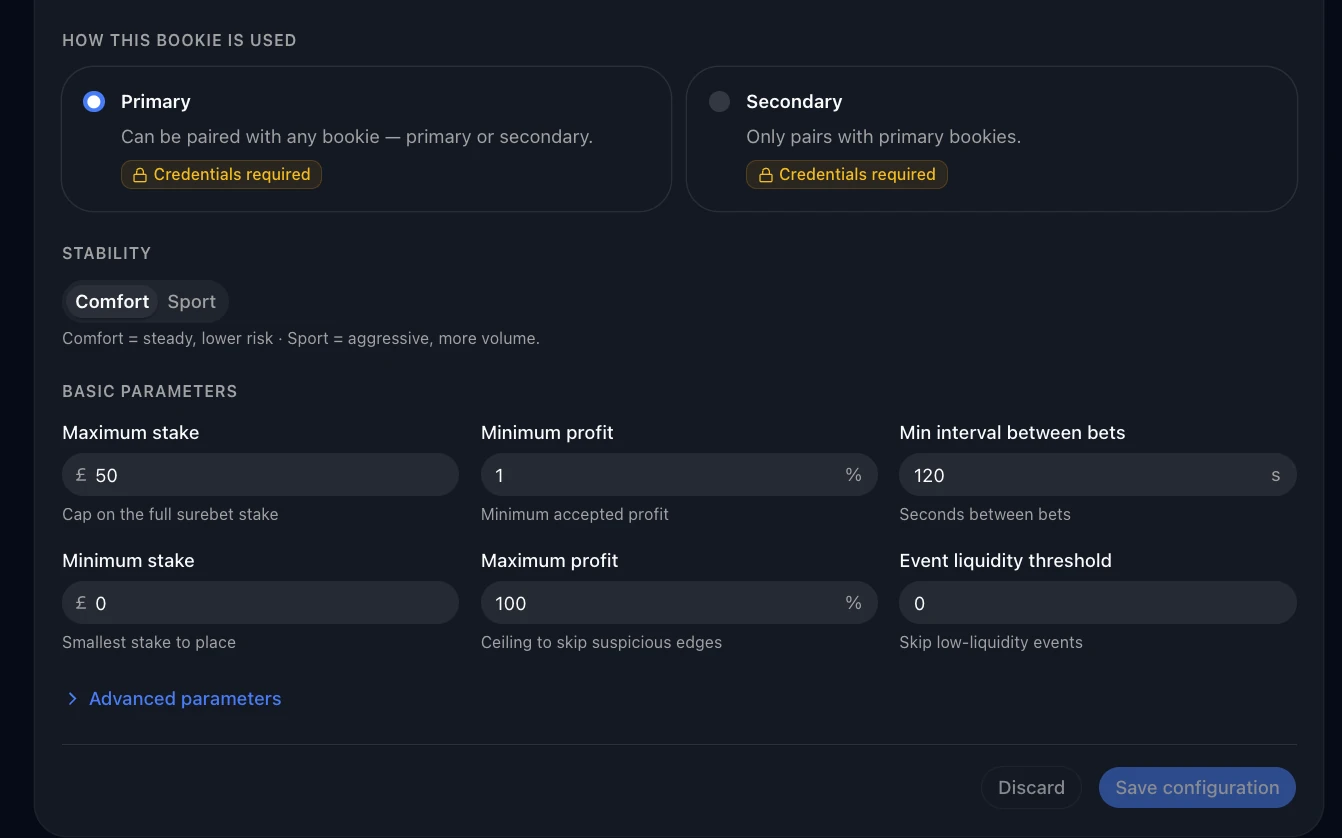
BetOven settings panel for a UK bookmaker account: stakes in pounds, accepted profit, interval between bets