An arb (a surebet, or arbitrage bet) is a combination of prices at different bookmakers, two or three depending on the market, that together cover every outcome and, staked in the right proportions, return more than the total staked: that difference is the arb’s margin. If you want the basics first, here’s what a surebet is and how to work one out. The quick check is to add up the inverse of each price (1 divided by the odds): if the total comes in below 1, there’s an arb.
The word “sure” oversells it a little. Once both bets are on, the maths is fixed; getting both bets on is not, and that’s what most of this article is about.
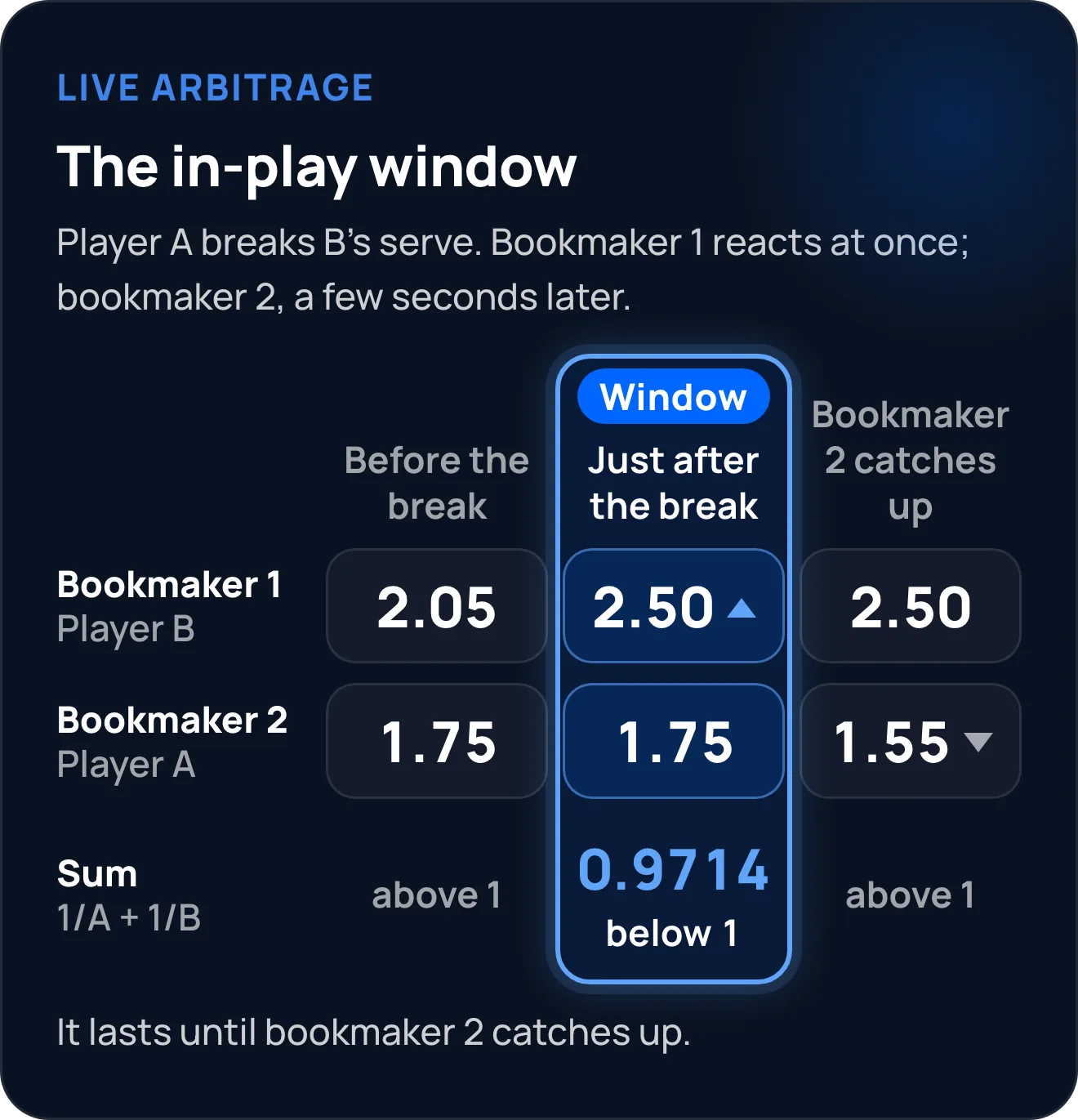
On a live bet the price moves with every passage of play, and bookmakers don’t all move it at the same time. Some take their prices from an external odds provider, others have their own traders, and each one suspends and reopens the market at its own pace after a goal or a break. For a few seconds, old prices and new ones sit side by side, and that lag is where in-play arbitrage comes from. You’ll also see these called live surebets or live arbs.
That’s why they turn up throughout the match, especially just after the score changes, and why they don’t last long: the slow bookmaker soon catches up.
You won’t find them by eye: you’d have to compare a dozen bookmakers at once while their prices change every few seconds. You find them with a scanner, which is odds comparison software that does the maths for you.
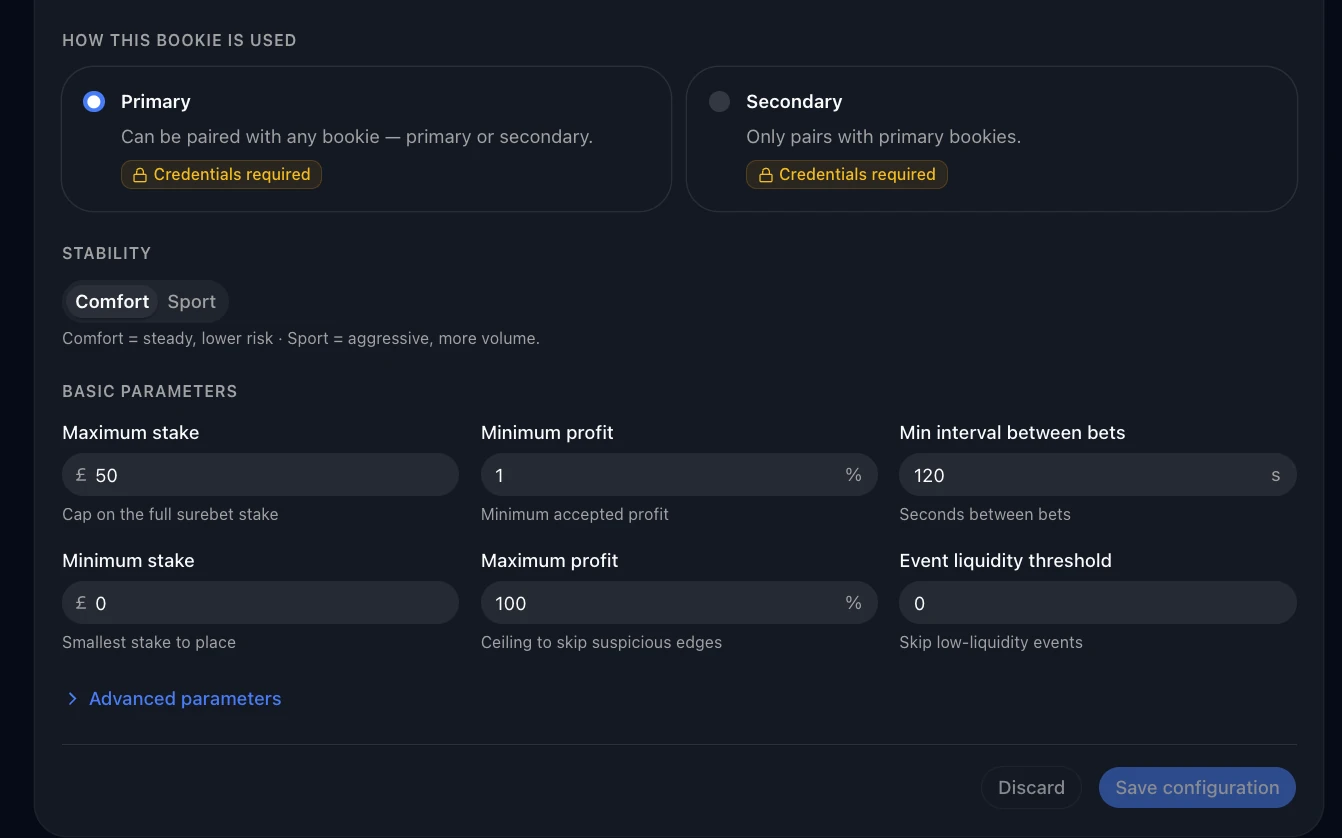
Ours is BetOven Scanner. It’s 100% free, with no paid version and no time limit, and it runs on Windows and macOS. It compares more than 80 bookmakers and shows surebets and value bets in-play only. It doesn’t place bets: it tells you where the opportunity is and you decide whether to place the bets by hand. It uses the same detection engine as BetOven Robot, the program that also places the bets on your accounts, although the two don’t cover the same bookmakers.
Whichever scanner you use, first make sure it covers the bookmakers you actually hold accounts with. Then, before betting, check four things on every arb:
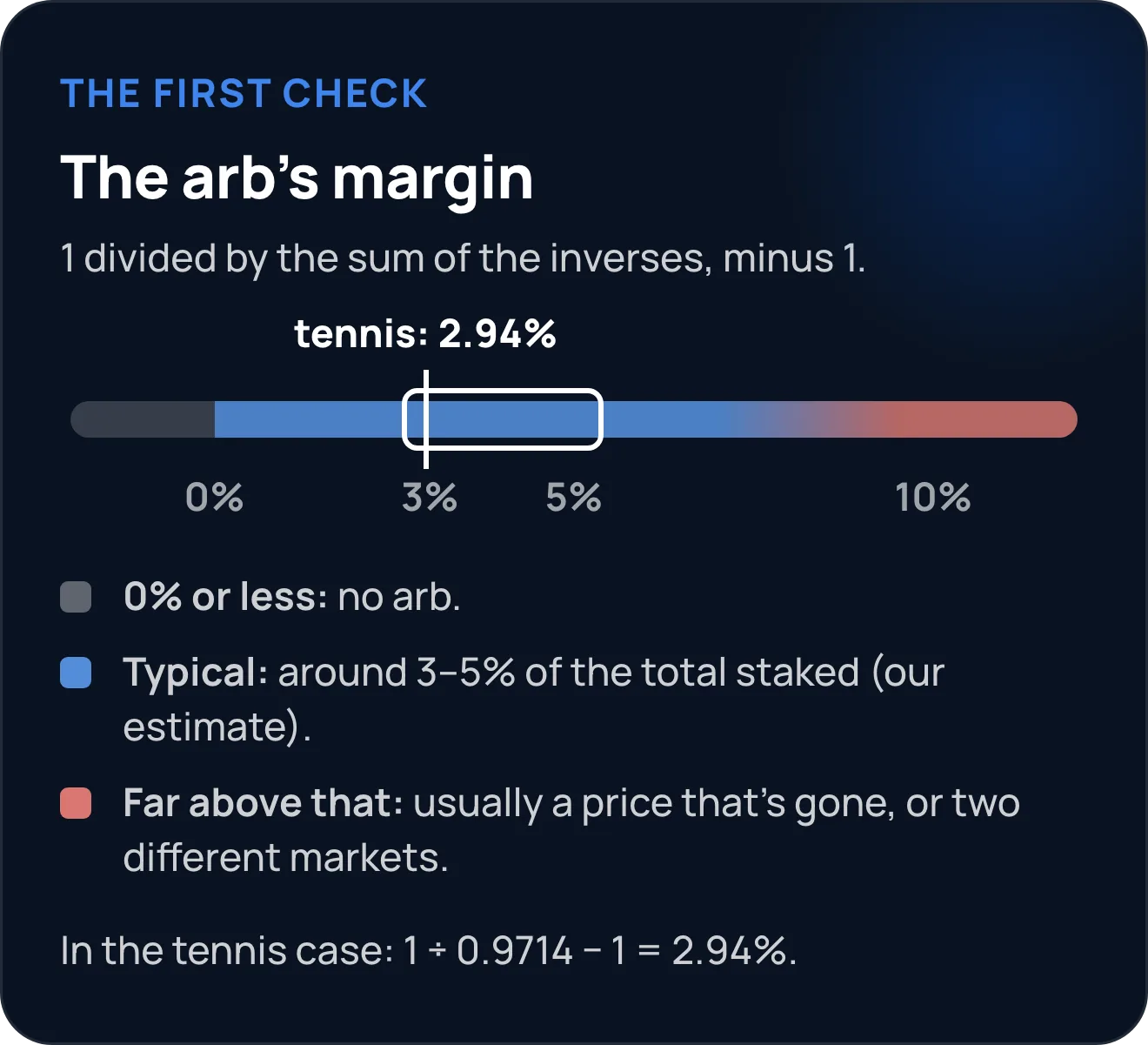
- The margin. On average, an arb’s margin is around 3–5% (our own estimate, not a measurement). One far above that is usually a price that’s no longer available, or two markets that aren’t actually the same.
- That the market is identical. Same match, same market and same line: “over 2.5 goals” is not “over 2 goals”.
- Each bookmaker’s rules. A retirement in tennis or overtime in basketball isn’t settled the same way everywhere (more on this under the risks below).
- That you have funds at both bookmakers. In-play there’s no time to make a deposit.
Take a tennis match and the match winner market, which has only two outcomes. Player A breaks B’s serve in the first set. Bookmaker 1 reacts straight away and shortens A; bookmaker 2 takes a few seconds and is still offering the pre-break prices:
| Player A | Player B | |
|---|---|---|
| Bookmaker 1 (already updated) | 1.55 | 2.50 |
| Bookmaker 2 (not yet updated) | 1.75 | 2.05 |
This is an example: the odds are made up, though realistic, and amounts are rounded to the penny. Prices are in decimal, which is what scanners and arb calculators work in; in fractional terms, 1.75 is 3/4 and 2.50 is 6/4.
The pair that works is A at 1.75 with bookmaker 2 and B at 2.50 with bookmaker 1. The check: 1/1.75 + 1/2.50 = 0.5714 + 0.4000 = 0.9714. That’s below 1, so there’s an arb, with a margin of 2.94% (1 divided by 0.9714, minus 1). To split your stake, divide the amount you want back by each price:
| Bet | Odds | Stake | Return if it wins |
|---|---|---|---|
| A with bookmaker 2 | 1.75 | £100 | £175 |
| B with bookmaker 1 | 2.50 | £70 | £175 |
| Total | £170 | £175 |
If both bets go on at those prices, you get £175 back whichever player wins: £5 more than the £170 staked, which is that 2.94% margin. The surebet calculator does this split instantly for any stake.
Now for what actually happens in-play. You place the £100 on A with bookmaker 2 first, because that 1.75 is the price that will vanish as soon as the bookmaker catches up. By the time you go for the second bet, bookmaker 1 has already moved B from 2.50 to 2.30. What do you do?
This is why you work out the break-even price of the second leg in advance (each of the bets in an arb is called a leg): the price at which you neither win nor lose. With A at 1.75 it’s 2.333, that is, 1 / (1 − 1/1.75). With B at 2.34 or more there’s still a margin; at 2.33 or less the arb no longer adds up. At 2.30 you have two ways out:
- Cover it anyway. Put £76.09 on B at 2.30 to get £175 back either way. As you’ve staked £176.09 in total, you lose about £1.09 whichever player wins: a small, known cost.
- Leave it as a single bet, what’s called a singlebet. If A wins, you get £175 back for the £100 staked; if B wins, you lose that £100. Because 1.75 was above what the rest of the market was paying, that lone bet is a value bet: on paper its expected value is positive, but that’s an average over many bets, and any single one can lose.
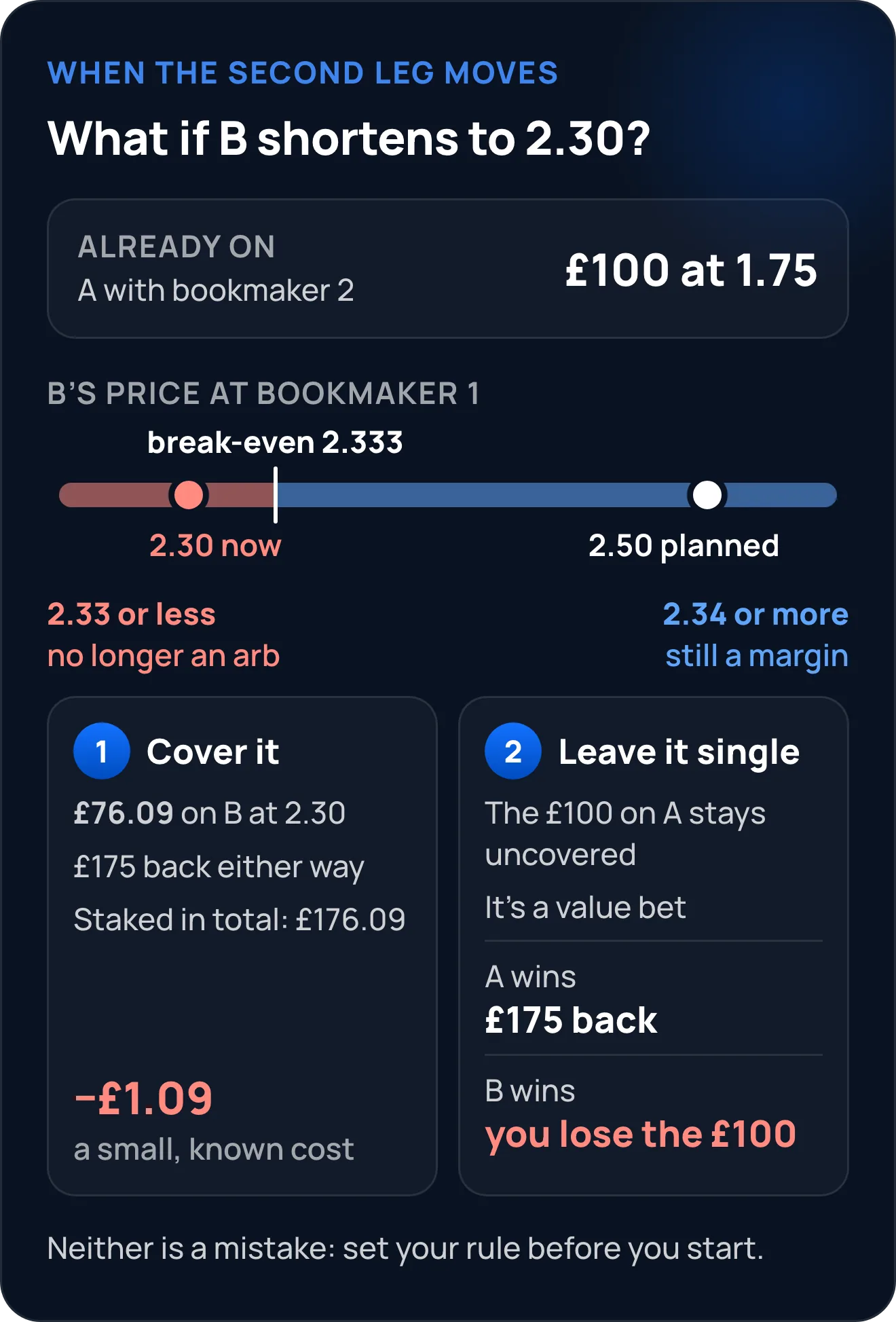
Neither option is a mistake. If your bankroll is tight or you don’t keep a record of your bets yet, covering costs little and spares you the swings. If you already bet at volume and the leg left open is the value one, leaving it makes sense over the long run: with BetOven, in fact, we recommend not closing those single bets at a loss. What is a mistake is deciding in the heat of the moment each time: set your rule before you start and apply it the same way every time.
Go back over the example: spot the arb, check the market, calculate, switch tabs, type the stake, confirm, go to the other bookmaker and do it all again. By hand, however quick you are, that’s several seconds per bet, which is exactly how long the window lasts. And you have to be at the screen when the matches are on: afternoons, evenings and weekends.
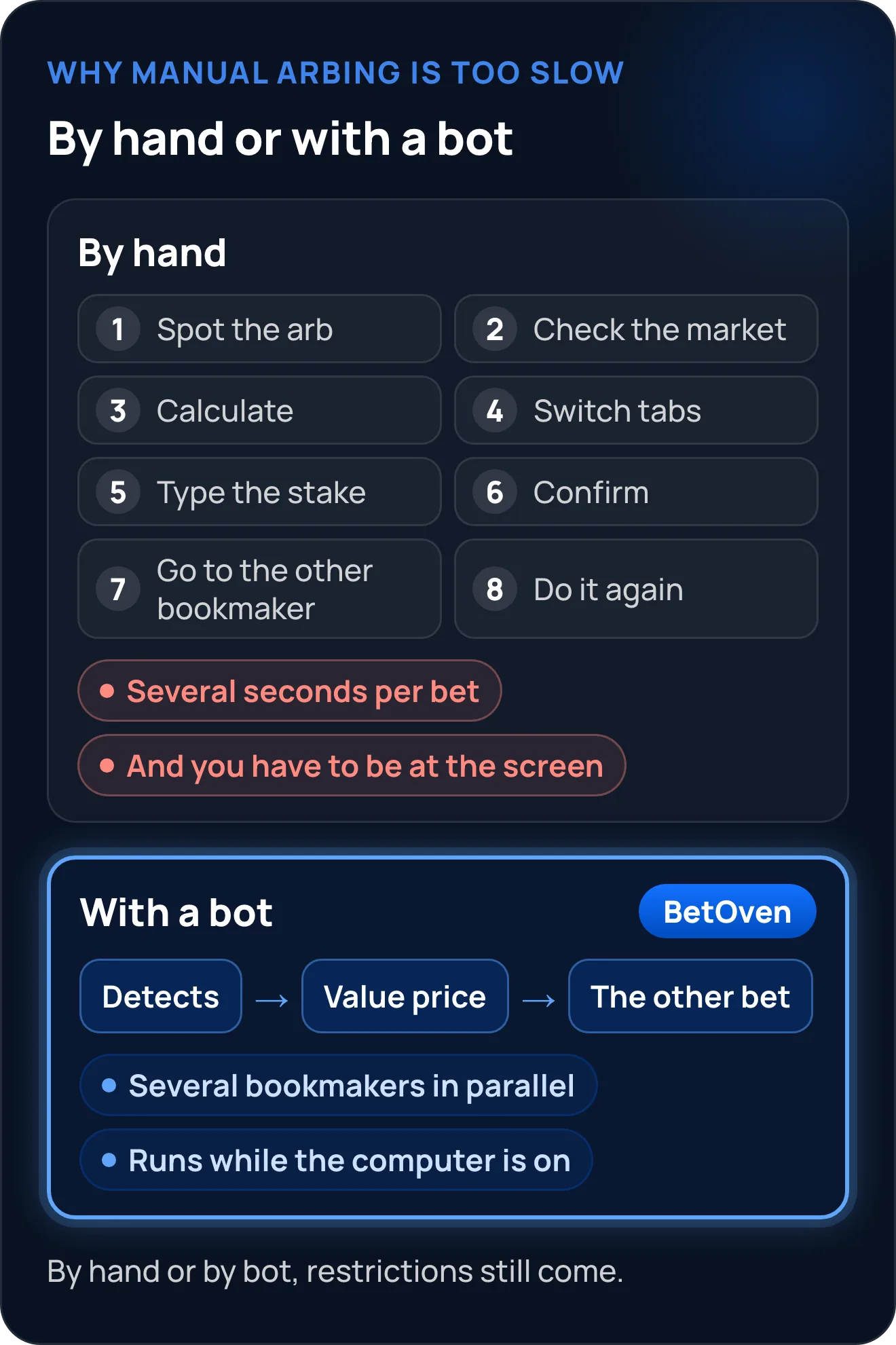
That’s where automated execution comes in. A surebet bot such as BetOven does what you would do, without the pauses:
- It detects and places live surebets and value bets on your own accounts, fully automatically and at several bookmakers in parallel.
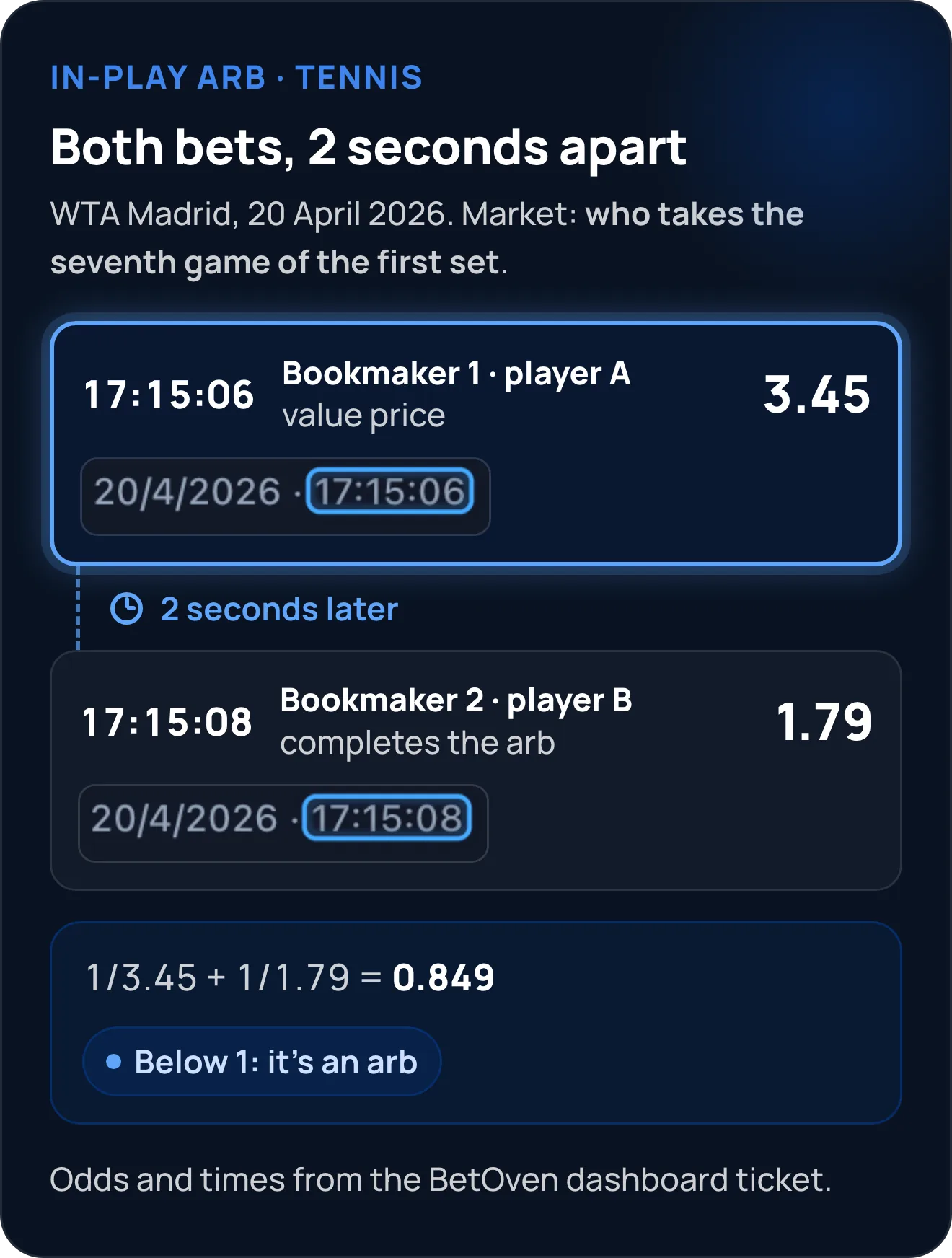
- It places the value price first and then the other one, the bet that completes the arb, which usually holds for longer: the same order as in the example.
- If a bookmaker caps the maximum stake, it completes the arb with several bets at that same bookmaker.
- It doesn’t decide in the heat of the moment. It always applies the rules you’ve configured, avoids the typing errors that come with rushing and doesn’t change strategy to chase a bad run.
- You don’t need to sit in front of it: you set bookmakers, filters and schedules once, and from then on it searches and bets on its own while the computer is on. In the app you see every bet it places in real time, and the web dashboard, with your history and balances, works from your phone.
Not everything changes with a bot. Around 3 in 10 of the arbs BetOven attempts end up as a single bet (that’s our average estimate, and it goes up if a bookmaker is restricting you); since it places the value leg first, that’s the one left open. Restrictions still come, and your job is to check profiles, balances and bookmaker changes regularly. BetOven is desktop software for Windows, built for people who already have experience with value betting or arbitrage. On a Mac it runs through Parallels or on a Windows server, which the hosting provider bills monthly with no minimum term; the server stays on, so your own computer doesn’t have to.
- Request the trialNo card needed. For people with value betting or arbitrage experience.
- We set it up with youOver AnyDesk: installation, bookmakers and filters. It runs on a Windows PC or a server that stays on.
- BetOven places the betsIt finds arbitrage (surebets) and value bets in-play and places the bets on your own accounts.

Hi! I’m Aitor Hunt. Before I got into sports arbitrage, I was a frustrated industrial engineer: just another cog in a big company, looking for a radical change.
That changed in 2018, when I came across software built by some friends from the Technical University of Madrid (BetOven), based on maths and automation. I was very sceptical at first (like almost everyone), but I started as a customer, tried it and saw how it worked first-hand. That’s how BetHunter was born. Today I’m here to explain how surebets and value bets work and how to automate them with method, knowing that the risk never goes away.