Odds comparison software shows you, on one screen, what every bookmaker is paying for the same outcome. It’s useful for two very different jobs: always taking the top price for a bet you were going to place anyway, and spotting gaps between bookmakers so large that they turn into a surebet (an arb) or a value bet.
If you’re after the tool itself: for the pre-match price of your weekend bet, any odds comparison site will do; to see which in-play gaps are surebets or value bets, there’s BetOven Scanner, which is free. And if you want to understand what you’re looking at, below you’ll find how to read an odds comparison, a worked example from start to finish and a table that tells you which price differences deserve your attention and which don’t.
Índice de Contenidos
ToggleWhat odds comparison software is
It’s a tool that pulls together the odds from lots of bookmakers for the same event and the same market, and highlights which one pays most. If you’re putting £50 on a player to win, the result of the match doesn’t depend on the bookmaker you choose, but what you collect if you’re right does. Comparing prices before you bet and always taking the highest is known as line shopping, or simply taking the top price, and it’s the simplest way to stop handing bookmakers extra margin.
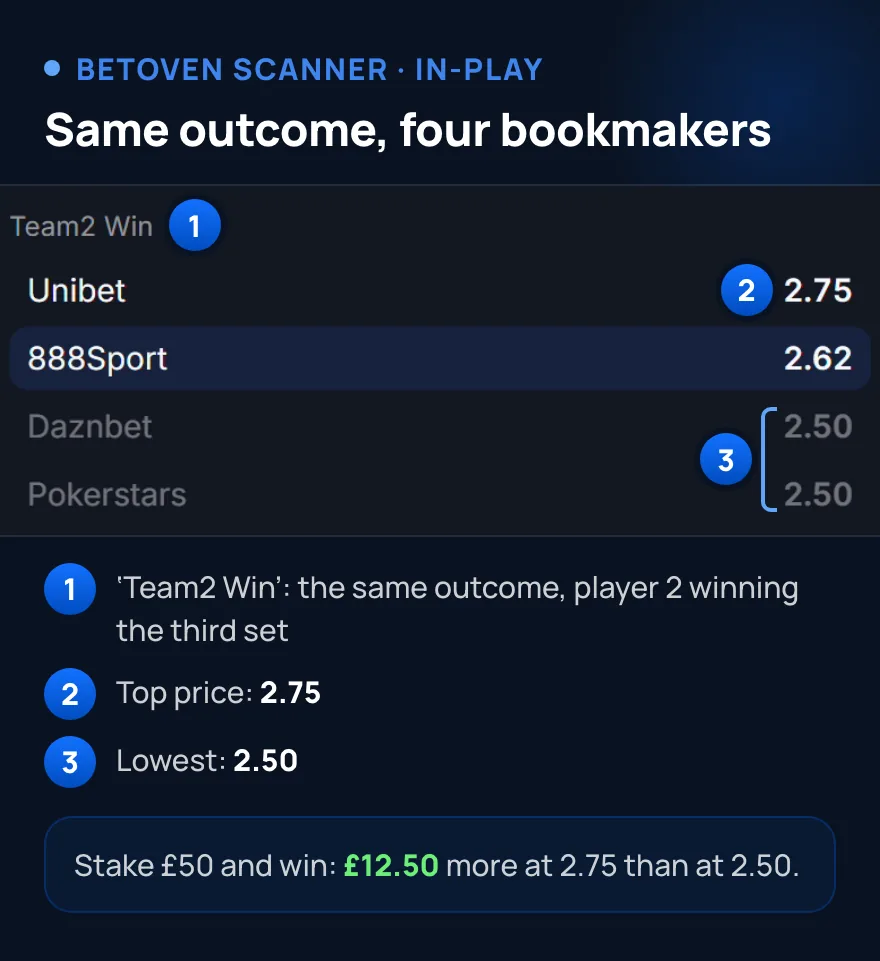
Sometimes, though, two bookmakers disagree so much on the price of the same outcome that you can cover every outcome with a margin, or back a price that pays more than it’s worth. The first is a surebet, also known as an arbitrage bet; the second, a value bet. To know when each one happens, you first need to understand why bookmakers don’t all pay the same.
Why every bookmaker prices the same event differently
There are three reasons, and you’ll see all three every day on any odds comparison site:
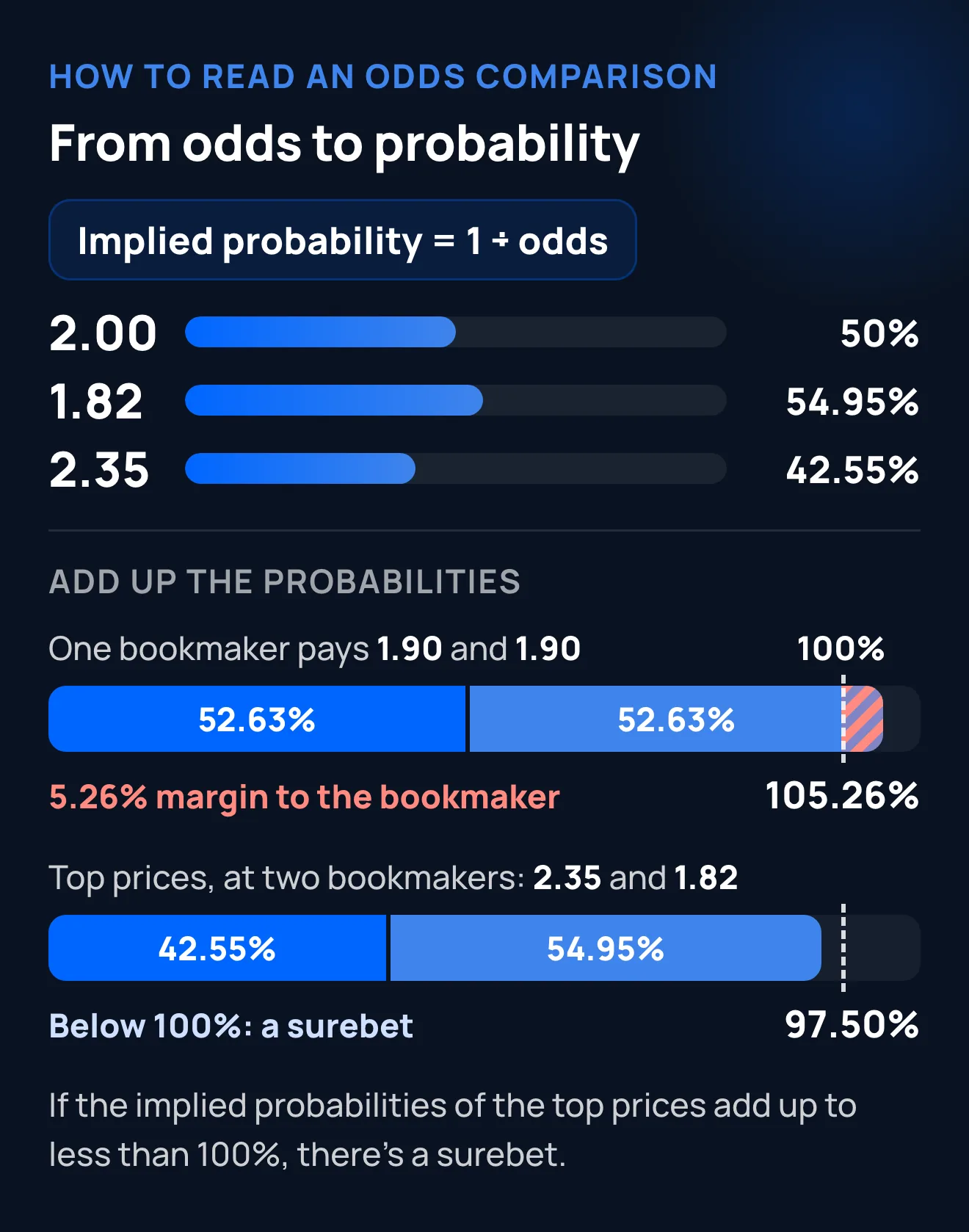
- Each bookmaker’s margin. No bookmaker pays the fair price: it keeps a margin, known as the overround. In an evenly matched tennis match, the fair price for each player would be 2.00 (evens). A bookmaker paying 1.90 (9/10) on both has a margin of 5.26%: the probabilities implied by its prices add up to 105.26%, not 100%. Each bookmaker decides how much to keep and how to spread it.
- Where the prices come from. Many bookmakers don’t set their prices on their own: they buy them from odds providers and then tweak them. Bookmakers that share a provider tend to move almost in step; the gaps appear between bookmakers on different providers.
- How fast they react. This is the one that matters most. When something happens in the match (a goal, a break of serve, a red card), each bookmaker updates its price at its own pace. For a few seconds, old and new prices sit side by side, and that’s where many of the most useful opportunities come from.
We’ll use decimal odds throughout. Most comparison sites let you switch from fractional to decimal, and the maths is far easier that way.
Types of odds comparison tool
They don’t all do the same job, so it’s worth knowing which one you need before you choose.
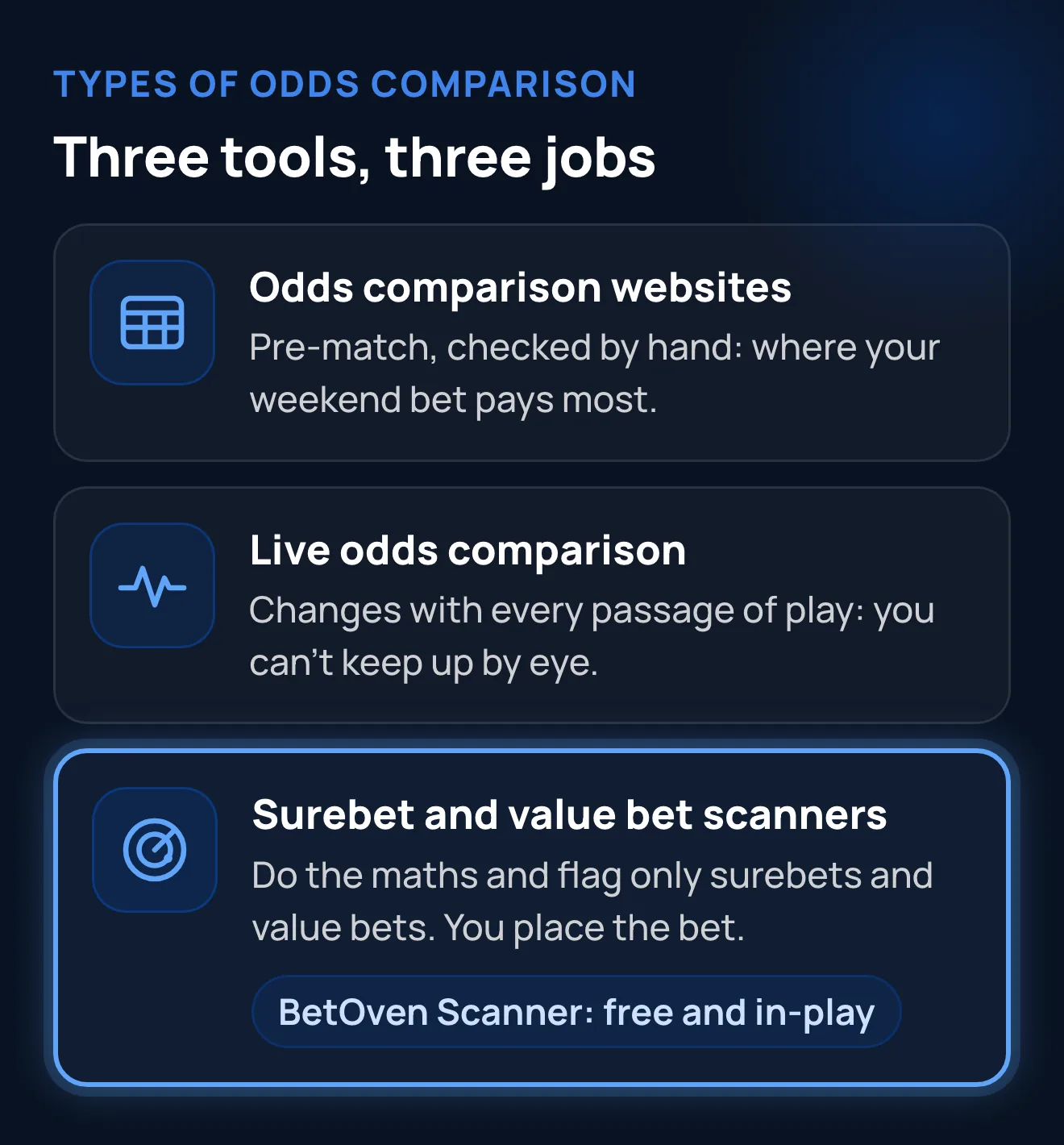
Odds comparison websites
This is what fills the first page of Google when you search for ‘odds comparison’: a site listing today’s football (and other sports) with what each bookmaker pays. It’s free, there’s nothing to install and it does its job well: making sure your weekend bet goes on wherever it pays most. The catch is that you have to check it by hand, and it doesn’t tell you whether a gap is an opportunity or just a different margin.
Live odds comparison
Many of those sites also show prices for matches already under way: that’s live, or in-play, odds comparison. Here the table changes with every passage of play. In football, a goal moves the match result, the goals markets and the handicaps all at once, and each bookmaker updates them at its own pace. You can’t keep up by eye: by the time you’ve found the price, it has often moved.
Surebet and value bet scanners
This is odds comparison software that does the maths for you: it cross-checks the prices of every bookmaker it covers and flags only the combinations where there’s a surebet or a price above its fair value. BetOven Scanner, our free scanner, is this type: it compares more than 80 bookmakers in-play and detects surebets and value bets. It doesn’t place bets: the decision and the bet are yours.
Worth knowing: the Scanner works in-play only. If what you want is to compare pre-match prices for your weekend bet, any odds comparison website will do.
Why in-play only? Because that’s where the most useful gaps appear. Pre-match prices are more settled and bookmakers find it easier to spot arbitrage, so accounts get limited sooner. That’s also why BetOven, our bot, works in-play only.
How to read an odds comparison: turn every price into a probability
Odds are a price, and every price hides a probability. To go from one to the other, just divide 1 by the odds:
Implied probability = 1 ÷ odds. Odds of 2.00 mean 50%; 1.82 means 54.95%; 2.35 means 42.55%.
With that one sum you can read the three things that matter:
- Each bookmaker’s margin: add up the probabilities of every outcome at that bookmaker. Whatever goes over 100% is its margin.
- Whether there’s a surebet: take the highest price for each outcome, even if they’re at different bookmakers, and add up their probabilities. If the total is below 100%, there’s a surebet.
- Whether there’s a value bet: compare one bookmaker’s price with the market’s fair price. If it pays more, there’s value.
One match, three bookmakers, three readings
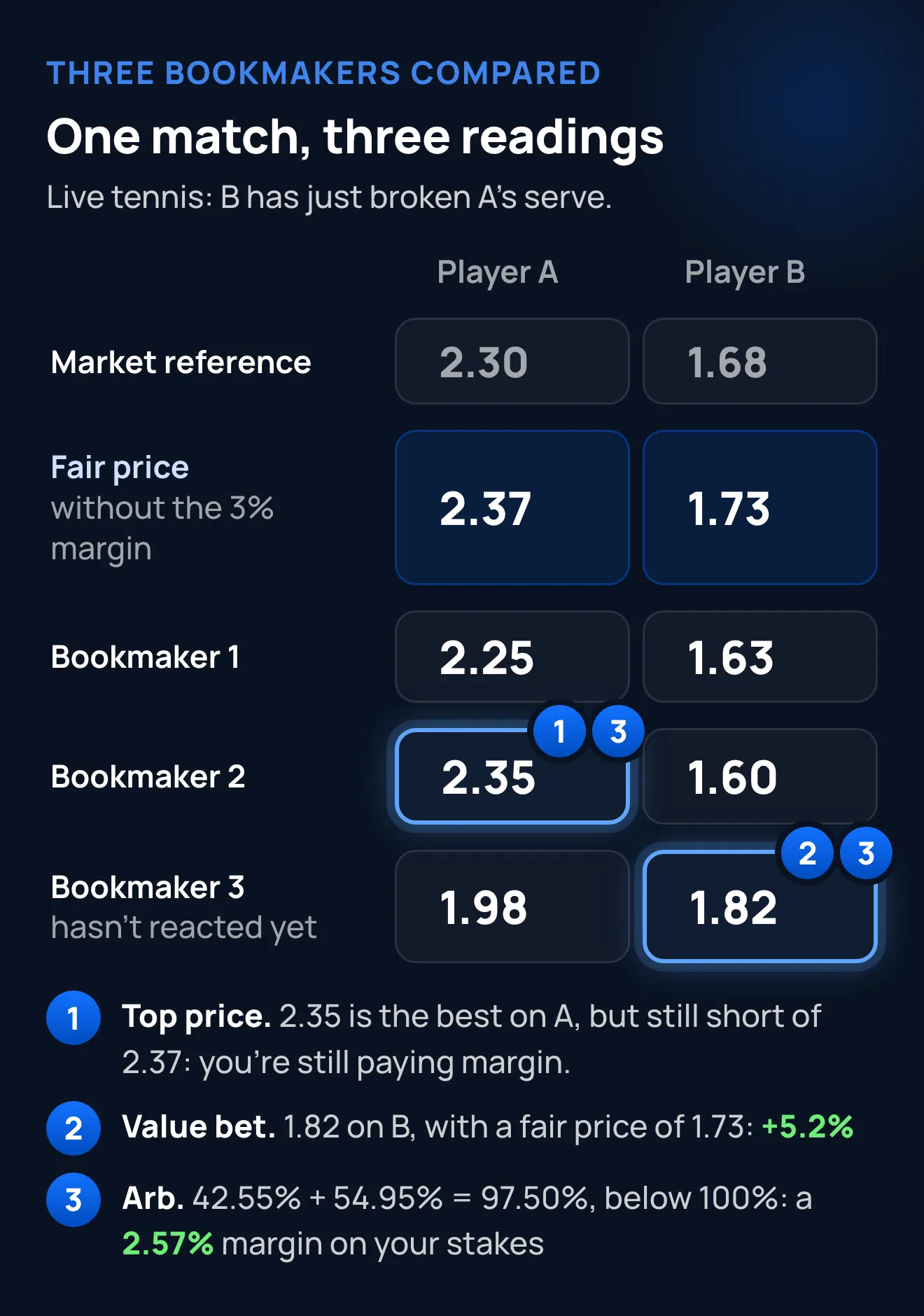
A live tennis match: player B, already a slight favourite (around 52%), has just broken A’s serve, and the market moves him to almost 58%. Bookmakers 1 and 2 have already moved their prices; Bookmaker 3 hasn’t yet. As the market reference we take a low-margin bookmaker: that’s what we use to estimate the true price (purely as a reference, not as somewhere we suggest betting). The odds are an illustrative example:
| Player A | Player B | Total implied probability | |
|---|---|---|---|
| Market reference | 2.30 | 1.68 | 103.00% |
| Bookmaker 1 | 2.25 | 1.63 | 105.79% |
| Bookmaker 2 | 2.35 | 1.60 | 105.05% |
| Bookmaker 3 (hasn’t reacted yet) | 1.98 | 1.82 | 105.45% |
Each bookmaker, on its own, charges its margin: none goes below 100%. The reference, with a 3% margin, is the tightest. Strip that margin out, sharing it proportionally between the two players, and you get the fair price: A at 2.37 and B at 1.73, in other words a 42.21% and a 57.79% chance. For A, the sum is 1 ÷ 2.30 = 43.48%; 43.48% ÷ 1.03 = 42.21%; and 1 ÷ 0.4221 = 2.37. B works the same way.
Taking the top price: the same bet at a better price
If you were going to put £50 on A anyway, the bookmaker matters. If A wins, your net winnings are £67.50 at 2.35 with Bookmaker 2; £62.50 at 2.25 with Bookmaker 1 (£5.00 less); and £49.00 at 1.98 with Bookmaker 3, which hasn’t reacted yet (£18.50 less). Against a normal bookmaker the difference is a few pounds; against one that’s lagging behind, quite a lot more. And it’s exactly the same bet.
Bear in mind, though, that the highest price on the screen isn’t a value bet: 2.35 is still below the fair price of 2.37. You’re paying less margin than at the other bookmakers, but you’re still paying margin.
Value bet: the price that hasn't caught up
Bookmaker 3 is still paying 1.82 on B, when his fair price is now 1.73. That price is 5.2% above what the market says it’s worth: it’s a value bet. A single one can lose, of course: value is a property of the price, and it only shows across a large number of bets, with ups and downs along the way. And it doesn’t last, because as soon as Bookmaker 3 reacts to the break, it’s gone. How much to stake on each one is a question the comparison can’t answer: it depends on how you manage your bankroll. One way to work it out from that 5.2% edge is the Kelly criterion, which has its pros and cons.
Arbitrage: when the total drops below 100%
Now take the highest price on each player: A at 2.35 with Bookmaker 2 and B at 1.82 with Bookmaker 3. Their probabilities add up to 42.55% + 54.95% = 97.50%. Because that’s below 100%, it’s a surebet:
- With £100 in total, the split that pays out the same whichever player wins is: on A, 100 × 1.82 ÷ (2.35 + 1.82) = £43.65, with Bookmaker 2; on B, 100 × 2.35 ÷ 4.17 = £56.35, with Bookmaker 3.
- If both bets are accepted at those prices, you get back £102.58 if A wins and £102.56 if B wins. Without rounding to the penny it would be £102.57 either way (100 × 2.35 × 1.82 ÷ 4.17).
- That’s a margin of 2.57% on the amount staked on that pair of prices. It doesn’t come from 100 − 97.50: an arb’s margin is measured against what you stake, not against the total of the probabilities.
Notice the condition in the second point: the margin only exists if both bets get on at those prices. The arb comes out of the value bet: B’s price at Bookmaker 3 is out of line with the market, while A’s at Bookmaker 2 is close to its fair price. So if you’re doing it by hand, place the value price first, because it’s the one that moves soonest: if the second bet doesn’t get on, you’re left holding a value bet rather than any old bet. BetOven follows the same order: it always places the value price first. What to do when the second bet won’t go on at its price (cover anyway at a small loss, or leave the first as a single bet) is worked through with a tennis example in our guide to live arbitrage betting.
To split your stakes without doing sums in a hurry, there’s our surebet calculator.
What each price difference means
A summary to keep to hand every time you look at an odds comparison:
| What you see | What it is | What to do |
|---|---|---|
| One bookmaker pays a little more than the rest, but below the fair price | Line shopping | If you were going to bet anyway, bet there, even if it’s only pennies. It isn’t a value bet. |
| A bookmaker pays more than the reference’s fair price | Value bet | Only makes sense across lots of bets: value shows over the long run, not in a single bet. |
| The highest prices on every outcome add up to less than 100% | Surebet (arb) | Cover every outcome with the exact split, and quickly. |
| One price wildly out of line with all the others (say, 3.00 where everyone else is around 1.65) | Often a bookmaker error or a market with different rules | Check the market and its rules before betting. If it’s only a little higher, like the 1.82 in the example, it’s usually a bookmaker that hasn’t reacted yet. |
| Pennies between similar bookmakers | Different margins | If you were going to bet anyway, take the higher one; there’s no opportunity to chase. |
Odds comparison for arbitrage: what the software has to get right
Looking at an odds table isn’t enough for arbitrage betting. The software has to do five things well:
- Compare every outcome in the market. In tennis there are two; in a football match result, three. If you don’t cover every outcome, it isn’t a surebet.
- Show you the opportunities as they appear. In-play, which is where the most useful ones are, they last seconds: you’re not going to find them by refreshing tabs.
- Cover lots of bookmakers. The more it compares, the more mismatches it finds, although the ones that count for you are bookmakers licensed by the UK Gambling Commission where you hold an account and have funds.
- Compare equivalent markets. Rules change from one bookmaker to another: what happens if a tennis player retires, whether extra time counts… Two prices on the ‘same’ market with different rules don’t make a surebet.
- Have the stake split ready, because there’s no time to do the maths.
BetOven Scanner is built for this: it works in-play, compares more than 80 bookmakers and only shows you the combinations where there’s a surebet or a value bet. It’s free, for Windows and macOS. Have a look at its list of bookmakers before you start: many are Spanish and Italian, and the ones that count for you are UK-licensed bookmakers where you have an account. And whatever tool you use, check each market’s rules (point 4) yourself before betting.
Compare live odds with BetOven Scanner
- 100% free, with no paid version and no time limit
- More than 80 bookmakers, on Windows and macOS
- Spots surebets and value bets in-play; you place the bets yourself
What odds comparison software can't do for you (and how to handle it)
Odds comparison software tells you where the gap is. What happens next depends on how you work:
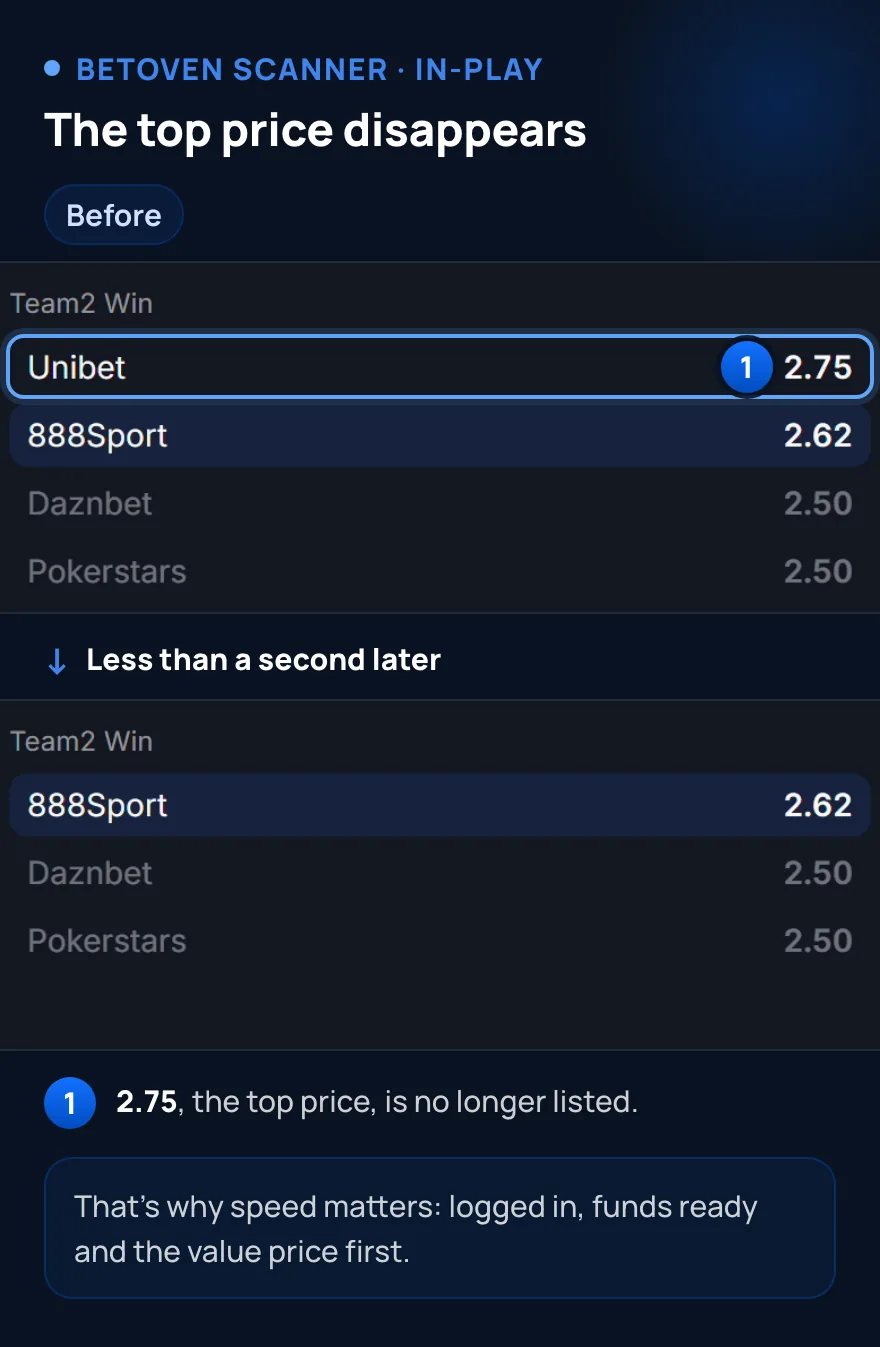
- Prices move in seconds. Between spotting the opportunity and placing the bet, the price can change or the bookmaker can suspend the market for a moment. What works is saving time: accounts already logged in, funds already deposited and the value price first.
- Limitations. Sooner or later, bookmakers limit anyone who wins systematically, whether they bet by hand or with a bot, and no tool prevents it. The way to handle it is to spread your betting across accounts at several bookmakers, one account at each, in your own name: when one limits you, you add another and carry on. The limitation doesn’t go away; it gets diluted.
- Funds spread across bookmakers. To cover a surebet you need money at both bookmakers at the same time. The fix is to keep a balance at the bookmakers where most of your opportunities come up.
- Time. Doing it by hand means being there. When that starts to weigh on you, the logical next step is a sports betting bot: BetOven uses the same detection engine as the Scanner and also places the bets on your own accounts, at the bookmakers in our ranking (all licensed in Spain, Italy or the UK), at several of them at once and without you sitting in front of the screen. It’s Windows desktop software that runs while your computer, or a Windows server you connect to, is switched on, and it’s designed for people who already have some experience with arbitrage or value betting.
Frequently asked questions
Is there free odds comparison software?
Yes. Odds comparison sites are free because they’re usually funded by bookmaker advertising and affiliate deals. BetOven Scanner is free too, with no paid version; the difference is that it works in-play and flags surebets and value bets instead of showing you the whole table.
Is there odds comparison software for Mac?
Odds comparison websites work in any browser. If you want a program that compares prices in-play, BetOven Scanner runs on Windows and macOS. The next step, BetOven, is Windows software: on a Mac you can run it with Parallels or on a Windows server you connect to remotely.
Is it legal to use odds comparison software in the UK?
Yes. Odds comparison software only shows you prices that bookmakers publish themselves. What matters is where you bet: in Great Britain, only with operators licensed by the Gambling Commission. Arbitrage betting isn’t illegal either; what can happen is that a bookmaker restricts your account, which is a commercial decision under its own terms.
Does odds comparison software place bets for me?
No. Neither odds comparison websites nor BetOven Scanner place bets: they show you the opportunity and you decide. For bets to be placed automatically you need a bot like BetOven, which detects surebets and value bets in-play and bets on your own accounts.
How big is a typical surebet margin?
Small. In our experience the average margin is around 3–5% of the amount staked on the pair of prices; the one in the example is 2.57%. It describes each pair of bets, not your results over a month, which depend on your bankroll, your bookmakers and how many bets get on at the quoted price. A much bigger margin is usually a pricing error or a market with different rules, and bookmakers can void bets struck at an obvious error under their palpable error rules.
18+ only. Please gamble responsibly. For free, confidential support 24/7, call the National Gambling Helpline on 0808 8020 133.
Hi! I’m Aitor Hunt. Before I got into sports arbitrage, I was a frustrated industrial engineer: just another cog in a big company, looking for a radical change.
That changed in 2018, when I came across software built by some friends from the Technical University of Madrid (BetOven), based on maths and automation. I was very sceptical at first (like almost everyone), but I started as a customer, tried it and saw how it worked first-hand. That’s how BetHunter was born. Today I’m here to explain how surebets and value bets work and how to automate them with method, knowing that the risk never goes away.