The word singlebet, as you can imagine, comes from English, and can be translated as single bet.
It is a concept that is rarely used in the betting world, but it makes a lot of sense when it comes to other strategies such as sports arbitrage.
Índice de Contenidos
ToggleWhen does a Singlebet occur?
If you are doing sports arbitrage (surebets) you already know that BetOven (our surebetting bot) places at least two bets when placing a surebet.
In a normal working situation, both bookmakers are set up as primaries and BetOven places the most unstable bet of the surebet first, the one that is more likely to change its odds or close its market.
Once this is done and the bet is closed, the other bet, the most stable, and therefore the one with the least chance of odds change or market closure, follows.
If when we are making a surebet, the second place bet changes its odds or closes its market, we will not be able to complete the surebet and we will be left with a single bet, or singlebet.
Additionally, we can also have a singlebet if there are limitations in one of the two bookmakers involved in the surebet.
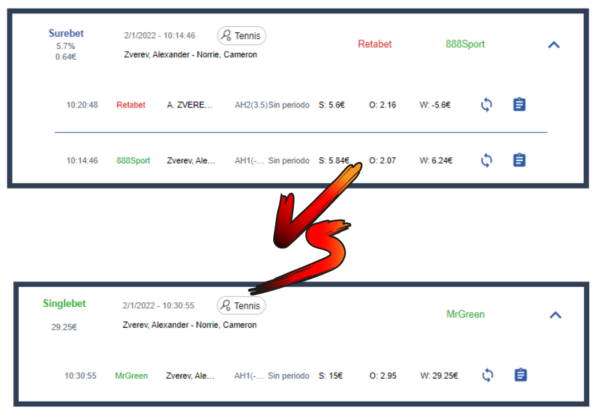
In other words, to simplify: a singlebet is a surebet that couldn’t be completed due to changes in the bookmakers. At least if we focus on this concept when we are making surebets.
Can we avoid doing Singlebets?
It all depends on the reason why we had that singlebet.
If the singlebet is caused by a bookmaker’s limitation, there is nothing we can do about it. If this singlebet is given by a market close, we will not be able to do anything either, as we will have no way of betting.
When a quota change occurs, there are two things we can do:
1. Automatic Singlebet Closing
If we do not modify the singlebet closing parameter BetOven will keep trying to close this surebet throughout the event, waiting for a favourable odds change to close it as a Surebet.
That is why it is very interesting to leave a singlebet unclosed when it has been produced by a change of odds.
2. Closing Singlebet as negative Surebet
If we have had a change of odds we can do so by closing this singlebet as a negative surebet, always from within BetOven. Modifying the parameter: Try to close profit singlebets with values greater than -100 such as -10 or -5. BetOven places the opposite bet itself and records it in your history.
Normally they are left open: BetOven doesn’t close them unless you enable this parameter and, in the meantime, keeps trying to close them as a positive surebet. On the other hand, they add volatility to the result.
If you would rather have less volatility, you can close them: instead of the swings of the singlebet, you take a small, known loss, smaller than the one you would take if the singlebet lost.
Both options are valid: leaving them open means more ups and downs; closing them, steadier results.
I leave the choice up to you to decide! Just remember: if you close them, always do it from within BetOven, with this parameter. Never close them by hand, placing the opposite bet yourself, or with a cash out: BetOven doesn’t take those bets into account, and that throws off your history and the calculation of your results.
Can we reduce the rate of singlebets?
Many times, we come across rookie arbers who ask us if it’s possible to avoid singlebets altogether. And the answer to this question is complex.
It really depends on the reason why the second bet in the surebet couldn’t be placed.
If the singlebet occurred due to a market closure, we won’t be able to avoid it, as there will be no available odds to place the bet.
If, on the other hand, it happened due to an odds change, there are still options to complete the surebet. Either because BetOven performs a second check and the odds change again, allowing us to close the surebet, or because we decide to close the surebet at a loss from within BetOven, with its parameter.
I’ll talk more about this second option later—for now, just keep in mind that some singlebets may eventually become surebets after subsequent BetOven checks during the event.
But there’s still one last reason a singlebet might occur: limitations applied to the bookmaker that was supposed to place the second bet and complete the surebet.
Can we reduce the rate of singlebets?
Singlebets caused by limitations in the second bookmaker are the ones we can avoid by conducting a thorough analysis of the bookmakers using different tools, such as the BetOven app’s history and its notifications section.
Doing a good job in this regard will reduce singlebets and, therefore, decrease BetOven’s volatility when operating in surebets mode.
Do singlebets have value?
In other words, by placing singlebets over time, will we make money?
The reality is that it depends on the market.
A singlebet is not a valuebet: even if the first bet comes from odds with value, it can lose that value during execution, because of the extra checks needed to secure the surebet, and it doesn’t have the yield of a valuebet. And if the singlebet is the result of a market closure or an odds change, the first bet will lose its value and lead to losses over time.
How much? In the case of Spain and the UK, I have to say that we will usually lose around one third of the profits made from surebets. What does this mean? Basically, we’ll keep two-thirds of the profits generated by surebets.
Bear in mind that this is a figure for the whole year: month to month it changes with volatility, and in some months singlebets end up positive and in others negative.
Can we reduce this volatility somehow? Yes, by taking a small, known loss on each singlebet you close: that’s BetOven’s singlebet closing parameter, which I explained above.
In the case of Italy, on the other hand, singlebets are more frequent and have more value: over the year, their result is positive. What is the reason for this difference?
Mainly, it’s due to the way many Italian bookmakers limit profits: by applying extra delays (almost from the moment we start betting with them).
In other words, in the case of Italy, we’ll have a higher rate of singlebets, which over the year improve our surebet results instead of reducing them, but will also bring more volatility to our results.
And that wraps up this explanation about singlebets. Now you know what they are, why they happen, and how they can impact your results with BetOven.
While they can’t always be avoided, understanding their origin and managing them properly will help you reduce their impact and make better decisions in your operations.
See you in the next video, hunter.
Videos on the subject of singlebets due to limitations:
Do you know BetOven?
If you don’t know him, I recommend you watch the following video… I promise you won’t be indifferent:

Hi! I’m Aitor Hunt. Before I got into sports arbitrage, I was a frustrated industrial engineer: just another cog in a big company, looking for a radical change.
That changed in 2018, when I came across software built by some friends from the Technical University of Madrid (BetOven), based on maths and automation. I was very sceptical at first (like almost everyone), but I started as a customer, tried it and saw how it worked first-hand. That’s how BetHunter was born. Today I’m here to explain how surebets and value bets work and how to automate them with method, knowing that the risk never goes away.